Turkey Stew Polenta

December 1st, 2012

Believe it or not, I’m still reheating Thanksgiving…

Leftover leftovers:
Turkey Polenta Cakes, served with salsa and guacamole

Turkey Polenta Cakes

A decidedly American take on the classic Italian dish

  • 1 cup onion, cut in 1/4-inch dice
  • 6 cloves garlic, sliced thinly
  • 2 cups sliced mushrooms, mixed varieties
  • 2 carrots, shredded
  • a couple cups of leftover turkey, picked from the bones and/or cut into small pieces
  • 4 cups turkey stock, made from the carcass of your Thanksgiving bird
  • 1 cup cornmeal
  • 1 stick of unsalted butter, divided
  • salt, pepper, ginger, and crushed red pepperto taste
  1. Heat a large (#10) cast iron skillet over medium heat. Once it is hot, add about 2 Tbl butter along with some black pepper and ginger. Let the butter melt, then add your diced onion and about 1/4 tsp kosher salt.
  2. Cook the onion for about 7-8 minutes or until the onion has started to brown at the edges, stirring about once per minute.
  3. Add the garlic and cook about 2 minutes, stirring 2-3 times.
  4. Add 2 Tbl butter, let melt.
  5. Add the sliced mushrooms, along with some ginger and a touch of crushed red pepper. Cook 10-15 minutes, stirring 1-2 times per minute. Pay more attention to the mushrooms the longer they cook. We’re looking for them to caramelize nicely but not to scorch or burn.
  6. When the mushrooms look gorgeous, add the turkey stock and bring it to a boil.
  7. Once he stock is at a rolling boil, whisk the cornmeal in at a steady drizzle. Add it slowly and keep that whisk moving in order to avoid lumps!
  8. Once the cornmeal has been incorporated evenly into the stock, turn the heat down to a simmer and add the shredded carrots into the pan. Cook at low heat, stirrign occasionally, for 30-40 minutes.
  9. At this point, you’ve got a really tasty cornmeal mush. I highly recommend taking a couple bowlfuls out for a meal or a side dish for today’s meal, because the polenta has to cool overnight before it’s ready to be made into the cakes (now you get what I meant above by leftover leftovers.). Plus this mush is delicious—it’s like turkey stew and biscuits all in one steaming bowl of goodness!
  10. Let the rest of the polenta cool or 20-30 minutes, then use a piece of parchment paper large enough to cover the entire pan to press it down to uniform depth.
  11. Let it cool a while longer to room temperature, then run a rubber spatula around the edge of the pan and invert the pan onto a clean countertop (with the parchment still in place). The polenta should drop out of the pan onto the parchment. Wrap it up and refrigerate it overnight.
  12. Day two, cut the polenta into cakes. Heat your skillet (which you should have cleaned in the meantime) over medium heat. Add 2 Tbl butter to the pan, let it melt. Cook half of the cakes in this butter, flipping after 5-6 minutes or when golden brown and cooking the other side for another 5-6 minutes. Remove to a sheet tray in a warm (200°) oven while you cook the other half of the cakes in the other 2 Tbl of butter.
  13. Serve with salsa and guacamole or your favorite condiments.

Quick N Easy Chunky Cranberry Sauce

November 25th, 2012

Cranberry Sauce is another element of Thanksgiving Dinner that deserves the personal touch of being homemade.  For years I have followed my mother’s recipe for a cranberry jelly, which is good, but is difficult to get just right and if undercooked, never really gels and goes to the table as a cranberry syrup that tends to be ignored.

This year, I decided to go off-recipe and create my own.  A couple of elements that I decided were crucial: it should be easy to execute, capture the tartness of the cranberries, and have some body to it.  If I hit those points, I reasoned, it would be a garnish that would make its way onto everyone’s plate.

The bowl was empty at the end of the first meal of leftovers.

Quick N Easy Chunky Cranberry Sauce

  • 1/2 stick butter
  • 1/4 cup minced fresh ginger
  • 4 1/2 cups fresh cranberries
  • 1 shot whiskey
  • 1 cup packed brown sugar
  • grated zest of 2 tangerines (or of 1 orange)
  1. In a large saucepan, fry the minced ginger in the butter over medium heat, stirring occasionally, for 5 minutes or until the ginger starts to take on a bit of a golden brown hue.
  2. Add 4 1/2 cups cranberries into the pan. Cook, stirring occasionally, until most of the cranberries have popped (several minutes).
  3. Add the shot of whiskey and light it on fire with a burning wooden skewer. Let it flame off. This will caramelize the sugars in a way that simply boiling it will not accomplish.
  4. Stir in the brown sugar and the citrus zest. Once these have been stirred in, simmer without stirring for about 7 minutes or until the sauce has taken on a very thick and bubbly appearance, sort of like lava looks in a low-budget film.
  5. Remove to a heat-safe glass bowl. Let cool briefly at room temperature before covering with plastic wrap and refrigerating overnight.

I’ll admit that some of Angstrom’s culinary proclivities are not ordinary for a two-and-a-half-year-old, but the little man was responsible, I think, for polishing off about a third of this sauce. He was such a fan of it that I actually didn’t get to eat quite as much of it as I would have liked to, so I am going to have to make another batch soon… maybe for Christmas; this recipe would also go quite nicely with ham.

Revolutionary Roasted Mushroom Pumpkin Pie

November 23rd, 2012

Happy Thanksgiving!

You may have noticed that another year has come and gone without me being invited to share my Thanksgiving tips on NPR.  I can’t say that I blame them.  I don’t have a book or a TV show, and it’s not like I’ve got a publicist or a manager booking high profile appearances for me.  So what makes me think I might deserve an invitation to appear on All Things Considered?  Because this pie is just the start of the meal.

Revolutionary Roasted Mushroom Pumpkin Pie capitalizes on the savory aspects of pumpkin and elevates your Thanksgiving appetizer course to a new level.

Revolutionary Roasted Mushroom Pumpkin Pie
A New Classic is Born in this Savory Appetizer Pie

  • 2 cups prepared pumpkin
  • 1 1/2 cups mixed roasted mushrooms seasoned with spices and rosemary (see note at end of recipe)
  • 3 eggs
  • 12 oz evaporated goat milk
  • 4 oz cow milk
  • 1 tsp kosher salt
  • 1 tsp ginger
  • 1/2 tsp cinnamon
  • black pepper to taste
  • homemade crust for a one crust pie (see note at end of recipe)
  1. Preheat oven to 450 degrees F
  2. Beat the eggs with the salt and spices.
  3. Add the evaporated goat milk and the cow milk, stir to combine.
  4. Stir in the prepared pumpkin and the roasted mushrooms.
  5. Roll out the pie crust, drape into a 9-inch pie pan. Pour pumpkin mixture into crust. Bake at 450 for the first 10 minutes. Reduce heat to 350 and bake for another 40-45 minutes or until the filling has mostly set (it should have puffed up slightly, have a thicker, jelled consistency, and be dull in color except for the very center of the pie).
  6. Let cool to room temperature on a rack before covering and refrigerating. Optional garnish: serve with lightly salted whipped cream
Notes on Recipe
Roasted Mushrooms

For the purpose of this recipe, I used a mix of crimini, oyster, royal trumet, and maitake mushrooms.  I sliced them to roughly 1/2-inch pieces and seasoned them before the roast with salt, pepper, ginger, and a generous pour of olive oil, tossing them until they were coated with spices and oil.  Their pre-roast volume was approximately 4-4 1/2 cups, enough to mostly fill a standard half sheet tray.  I roasted them at 375 F for approximately 45 minutes, stirring them after 15, 25, 35, and 40 minutes; moving the pieces from the edge of the tray into the center to maximize caramelization and avoid scorching.  Immediately upon removing the finished mushrooms from the oven, I tossed them with 1/4 cup minced rosemary.

Pie Crust

A homemade pie crust is always superior to a store bought crust, as it shows a level of care and pride that can not be matched with a manufactured product.  Furthermore, you can determine the ingredients in a homemade crust.  I like to season my crusts with the same spices that I use in the pies.  I also use butter as the fat in my crusts.  Should you choose to use butter, be certain to keep the crust entirely contained in the pan as butter is a soft fat and anything hanging over the edges will droop, drip, and drop to the bottom of the oven, setting off your smoke detectors and creating a mess that will need to be cleaned.

Whipped Cream

Beat 4 oz heavy whipping cream with 1/4 tsp salt and a sprinkling each of ginger, cinnamon, and nutmeg.

Please share this page with everyone you know (especially if you know Steve Inskeep and Robert Siegel). Just be certain to give me credit—I don’t want to hear Nigella Lawson giving this recipe over the air!

A Basic Sourdough

November 14th, 2012

Several years ago, when I was still working in a restaurant where I occasionally had a shift baking, I did pretty well at maintaining a sourdough starter.  Then, and it’s tough to remember the exact sequence of events, but I think that breaking my leg was somehow involved, I killed the yeast.  Found it one day submerged in a pool of pink slime.  I can’t say I was really devastated, or even surprised.  I’d gotten off track with my starter, hadn’t even glanced at it in well nigh a month at that point.

Still, it was nice to be able to whip up bread with nothing but flour, water, and salt.

I’ve been maintaining a new starter for about a month now.  It was a gift from Brett (of the chocolate sourdough fame) and it has been pretty easy to maintain.  So far, at least.  And I’ve made some fantastic bread and an amazing pizza crust from the resulting dough.

It’s often been said that baking is a science and one must rigorously follow formulae to get the desired result.  I disagree.  If I were to have rigorously followed the formula for pain au levain that I used as a starting point for my dough making, I’d have come up with a ‘dough’ that more closely resembled a puddle.  “Resist the temptation to add more flour,” the recipe said, “this dough should be quite soft.”  I’m quite content to have ignored that bit of advice.

A couple of batches of bread feeling out the consistency under my belt, I decided to take more careful stock of the measurements.  Perhaps get a formula of my own that is somewhat replicable.  No idea if this will work for you, but it seems to do the trick for me.

Basic Sourdough Formula

  • 38 ounces (by weight) fed starter
  • 3 lb unbleached all purpose flour
  • 25 oz water
  • 2 Tbl kosher salt
  • 4 oz additional flour
  1. Your starter should have been fed within the last 2-6 hours.  You should have measured out about 12 oz of it and returned it to its home in a glass canning jar in the fridge.  The 38 remaining ounces are enough to make about 3 loaves of bread and 2 pizzas.  If that’s more bread than you want, give some of it away, or discard some of the starter and reduce proportionately the remaining ingredients.
  2. Use cold water, preferably water that has had several hours to sit since having come from the tap, so that the chlorine included in most tap water will have had a chance to dissipate.  Or use bottled water if you must, but from a waste reduction standpoint, I would highly encourage against that.  Heat the water to 100 degrees F.
  3. Combine the water and the starter.  Add the flour and mix.  Cover with a clean dishcloth and let sit about 30 minutes.
  4. Mix the salt into the dough by kneading it on a heavily floured surface (that’s what the additional 4 oz of flour are for).  Don’t put all 4 oz down at once.  Start with about 1/3 of it and add more as needed.  When you have a dough that is smooth, elastic, and only a little bit sticky, return it to the bowl, cover it with the dish cloth, and let it rise for an hour or two.
  5. Gently deflate the dough by separating it from the side of the bowl and pushing down on it gently.  Cover with plastic wrap and put in the refrigerator overnight, or up to 3 days.
  6. Remove from the fridge.  Divide into portions and let sit at room temperature to warm back up.
  7. For pizza:
    1. Grease the bottoms of two standard half sheet trays.  Stretch the dough by hand to cover most of the area.
    2. Spread with sauce, sprinkle with cheese, and add the toppings of your choice.
    3. Bake in a preheated 450 degree F oven for about 30 minutes or until done.
  8. For bread:
    1. Shape loaves.  Let proof for about 30 minutes to an hour.
    2. Heat cast iron pans flipped upside down in a 400 degree F oven, plus a small cast iron pan rightside up at the very bottom.
    3. When the bread has proofed, transfer it to the hot cast iron pan bottoms.  If doing two loaves on the same pan, allow adequate space so that they don’t grow together in the oven.  Should that happen, the parts that are ‘kissing’ will still be doughy when everything else is done.
    4. Pour some water into the rightside up pan and also scatter some on the floor of the oven.  A huge cloud of steam will result.  Close the oven door quickly to keep it contained.  Watch out for steam burns!
    5. Set the timer for 20 minutes.  When it rings, remove the pan of water from the oven.  Steam for the first 20 minutes will help to produce a beautiful crust, but you need dry heat to finish it.  Set the timer for another 20 minutes.
    6. The bread is done when golden brown with a crackling crust and it sounds hollow when thumped from beneath.  Remove it to a rack to cool.

If you want to know how to start a sourdough starter, there are plenty of great resources that you can find to guide you.  Strange but true culinary school tidbit… when I was in the baking rotation of culinary school, the sourdough recipe they taught involved no starter.  Instead, they added pickle juice to the dough to give it tang.  I was incensed.  “That’s not a real sourdough!” I protested.  The chef instructor said, “wait til you taste the bread.  That dough really is sour!”

Pshaw!

Promise to Hike Next Year?

October 24th, 2012

Giant Eagle has “locked in” lots of prices until January 3.

Is it just me, or does that seem like a promise to raise prices on January 4?

Amazing French Toast

October 21st, 2012

My friend Brett has been making lots of bread.  His chocolate sourdough was the inspiration for one of the most delightful french toasts I’ve ever made.

Cream Cheese and Almond Butter Stuffed
Chocolate Sourdough French Toast
with Bananas Foster Sauce

  • 1 loaf chocolate sourdough bread, sliced thinly (pieces kept in order)
  • 4 ounces softened cream cheese
  • 1/2 cup almond butter
  • 3 eggs
  • About 1/2 cup of milk
  • spices as you like for the batter
  • 3 Tbl butter (plus more for the griddle)
  • 4 1/2 Tbl brown sugar
  • 1/2 tsp cinnamon
  • 1/2 tsp ginger
  • 6 bananas, sliced into thick chunks
  • 1/2 cup dark rum
  1. Mix the almond butter and cream cheese together. You’ll wind up with a spread the consistency of processed peanut butter.
  2. Make a bunch of cream cheese and almond butter sandwiches with the bread.
  3. Mix together the eggs, milk, and spices for the batter (I typically use cinnamon, allspice, ginger, nutmeg, and cardamom) in a shallow baking dish.
  4. Put the sandwiches in the eggwash, let them soak briefly; flip to soak the second side, then cook in butter on a hot griddle as you would for any other french toast.
  5. For the fosters, heat the butter and brown sugar in a saute pan. Stir together with a wooden spoon. Let the mixture get hot and bubbly.
  6. Add the bananas. Toss to coat with the sugar. They’ll release some juice, thinning out the sugar sauce. Add the rum. Let it get hot, then use a bamboo skewer like a long match to flame the rum without singeing your arm hair. Let the flame burn out. This will burn off all the alcohol in the rum whilst caramelizing the sugars.
  7. Serve the french toast topped with a generous measure of bananas foster sauce.

Photographic Proof of Breyer’s Falsehoods

October 15th, 2012

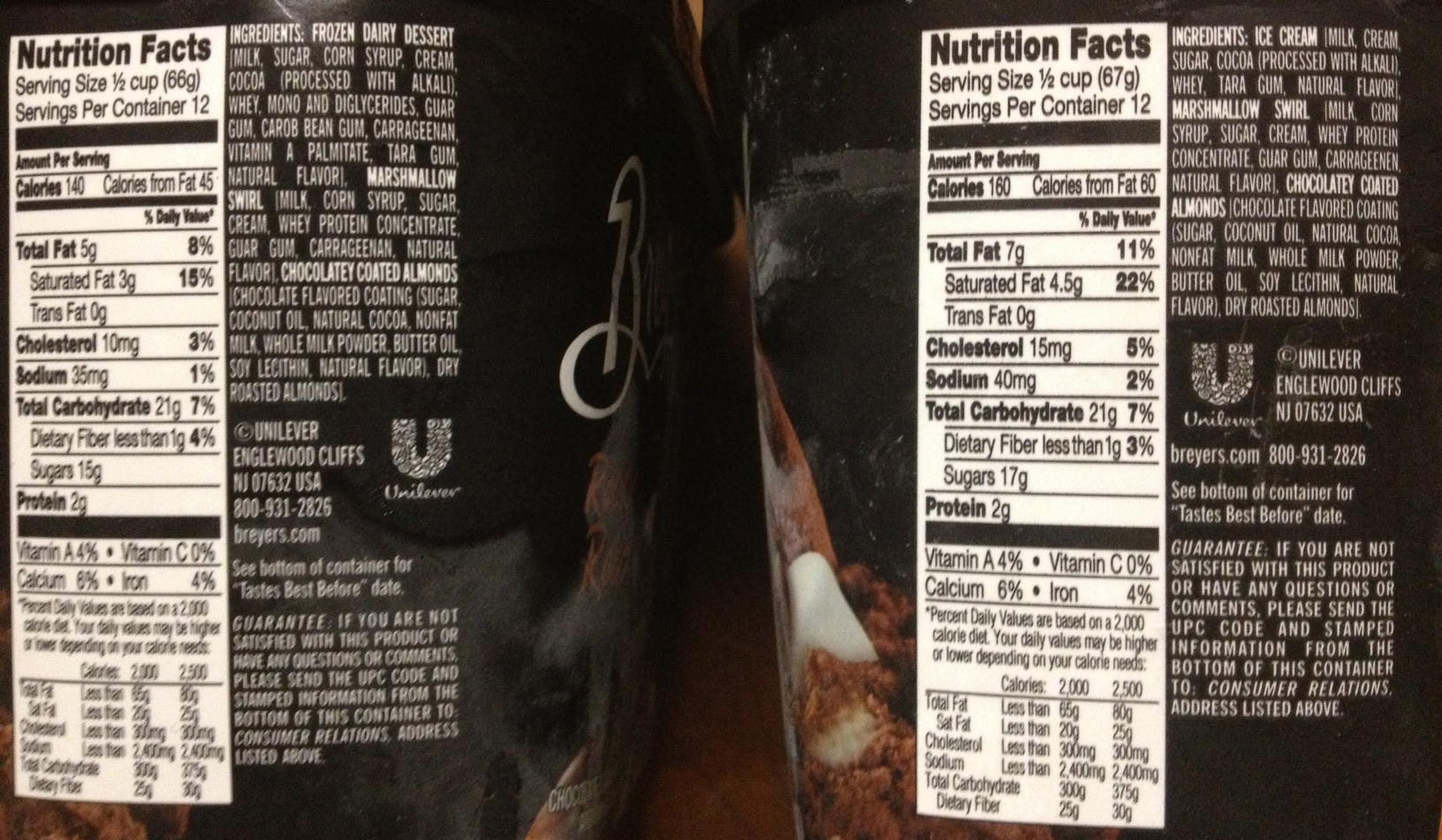
Here’s the photographic proof to verify my allegation that the folks at Breyer’s are telling a falsehood when they describe frozen dairy dessert as being made with ‘many of the same high-quality ingredients’ as their ice cream, ‘including fresh milk, cream, and sugar.’

I’m sure their lawyers will tell you that the phrase “many of the same” and the presence of milk, cream, and sugar in the frozen dairy dessert means that they are not lying.  But as anyone even remotely schooled in logic and rhetoric can tell you, there are two types of lies: lies of omission and lies of comission.

The phrasing of Breyer’s claim is intentionally designed to gloss over the addition of corn syrup into the formula.  Also to gloss over the addition of mono- and di-glycerides, guar gum, carob bean gum, and carrageenan.  Basically, more emulsifiers and thickeners to disguise the lower-quality ingredients, resulting in a different texture and an overall cheaper (read: not worth buying) product.

Click on the small picture for a full-sized photo.

Those Bastards at Breyers

October 12th, 2012

Breyer’s is no longer ice cream.

Breyer’s now manufactures “Frozen Dairy Dessert.”  According to their website,

Frozen Dairy Dessert products are made with many of the same high-quality ingredients that are commonly found in Ice Cream – like fresh milk, cream and sugar – and offer a great taste and even smoother texture. These products do not fall within the current FDA definition of standardized Ice Cream, so we call them Frozen Dairy Dessert.

The thing is, what Breyer’s does not acknowledge in this description is that a side-by-side comparison of the ingredients in like flavors from before and after the switch, their frozen dairy dessert is partially sweetened by corn syrup, whereas their ice cream was sweetened only with real sugar.

Again, from the Breyer’s website:

In a national side-by-side taste test, our fans tell us they like the new recipe just as much as the original. We’re confident these new products deliver the great taste Ice Cream fans expect but with any product change it’s always possible that you may notice a difference. Frozen Dairy Dessert tends to have less fat than ice cream.

Okay, so
1) the frozen dairy dessert has a somewhat slimy texture (even before I discovered the labeling switch, my immediate reaction to the box of Rocky Road I purchased was that there was something off with the contents) and
2) I don’t want less fat with my ice cream. If I wanted less fat, I wouldn’t be eating ice cream, now would I? Don’t go effing with my dessert formulae in the name of better health and then swap out real sugar for a processed alternative sweetener and then lie about it!

Again, official propaganda from Breyers:

Since 1866, Breyers products have consistently delivered high-quality ingredients, great flavors and smooth creaminess that our fans love, and we remain committed to that Pledge. Our Ice Cream and new Frozen Dairy Dessert varieties continue to use fresh milk, cream and sugar. What distinguishes our Frozen Dairy Dessert from our Ice Cream is that it’s blended in a whole new way to create a smoother texture.

My revision:

From 1866-August 2012, Breyers products had consistently delivered high-quality ingredients, great flavors, and smooth creaminess that our fans loved. In a short-sighted change prompted by allowing individuals lacking a love of high quality foods to make decisions crucial to the integrity of our product, Breyers has ceased to deliver upon our Pledge to quality. Our Frozen Dairy Dessert uses corn syrup as one of its primary sweeteners whereas our ice cream used only real sugar. We blatantly lie by omission about the ingredients in our frozen dairy dessert by not acknowledging the presence of the corn syrup in our marketing materials. What distinguishes our Frozen Dairy Dessert from our Ice Cream is a clear and noticeable drop in quality. We’re stupid pricks who should immediately renounce this change in formulation, fire everyone responsible for it, and issue a huge public apology in the same manner as Coca-Cola did following their New Coke debacle.

What’s For Dessert? Nothing!

October 9th, 2012

Except that by Nothing, I definitely mean something good.

The name for this dish is a side effect of asking a 2-year-old what he thinks a new dish should be called. 

I guess it shows that Angstrom has a sense of humor, though, because the second time I made it, he laughed every time I told him that I was putting Nothing in the oven and giving him Nothing on a plate.  Rory suggested I ought to give this dish a different name, but I sort of agree with Angstrom: Nothing is a funny name for something to be called.

Nothing

  • 1 butternut squash or 2 acorn squashes, halved and seeds scooped out
  • 1/2 cup + 1/4 cup brown sugar
  • 1/2 cup rolled oats
  • 1/4 cup flour
  • 1/4 cup + 1/4 cup butter, melted
  • 1 tsp + 1/2 tsp cinnamon
  • 1/2 tsp + 1/4 tsp ginger
  • 2 dashes nutmeg
  • 1 cup fresh or frozen cranberries
  • 1/2 cup pecan halves
  1. Preheat oven to 375 F.  Place squash cut side down in a casserole dish.  Add about 1/2 inch water.  Bake for an hour.
  2. Combine 1/4 cup brown sugar with flour, oats, 1/4 cup butter, 1/2 tsp cinnamon, 1/4 tsp ginger, and one dash nutmeg to make streusel topping.
  3. Let squash cool, then scoop out of its skin with a spoon.  It should come out pretty much mashed.  Combine in a mixing bowl with 1/2 cup brown sugar, 1/4 cup butter, 1 tsp cinnamon, 1/2 tsp ginger, and 1 dash nutmeg.
  4. Stir cranberries into squash mixture, then spread into casserole dish.  Top with pecan halves and streusel topping.  Bake in 375 F oven for 30-45 minutes and serve.  Invite toddlers to your table so that you get a big laugh when you make a big deal out of serving Nothing for dessert.

Cast Iron Makes a Huge Difference

September 29th, 2012

I got some church lady pierogies this week and brought them home to cook.  I always cook lots of vegetables to go with them.  This week, it was onions, garlic, mushrooms, hot pepper, and bell peppers.  My copper-bottomed stainless steel was out and handy, so I used it.

I got about halfway through adding the vegetables into the pan and realized that it was getting a bit crowded, so I grabbed my ceramic-lined cast iron off of the pot rack (the only cast iron that hangs—the rest sit in the cupboard being so heavy that they’ve bowed the cupboard floor.  Whenever we get around to redoing the kitchen, we’re going to have to install a specially reinforced cupboard with custom-built organizational slots to accommodate my collection).  I fired up the heat under that pan and transferred about half of what was in the stainless pan to the new one once it got hot.

Even though my stainless pan was over the so-called ‘power burner’ on my stove, and even though I actually had more gas burning under it than I did my cast iron pan, the vegetables in the stainless pan were cooking but not taking on any color while the ones in the cast iron pan were taking on a beautiful caramel hue.  I wound up doing multiple transfers/ retransfers between the two pans to get all of the veg to caramleize properly.

My Standard Pierogie Vegetable Mix Recipe

Slice onions, garlic, mushrooms and peppers.  Add about a half stick of butter to a hot pan.  Once it has mostly melted, put the onions into the pan along with a pinch of salt and black pepper to taste.  Cook over mediumish heat, stirring about once a minute.  Once the onions have softened and are starting to brown, add the garlic.  Cook for 1-3 minutes until it starts to brown.  Add the mushrooms and cook, stirring occasionally, until they have shrunk and taken on some color.  (if your pan is getting too full, divide between two pans).  Add the peppers and cook until they have softened.

One-pan instructions

Remove the cooked vegetables to a plate to hold.  Add the other half stick of butter to the pan.  Brown the pierogies in the butter, flipping just once.  When the pierogies have browned, return the vegetables tot he pan.  optional: Add chicken or vegetable stock and reduce over high heat to a sauce.

Two-pan instructions:

Put all of the vegetables in one of the pans.  Add chicken stock and reduce over medium-high heat to a sauce.  Meanwhile, add the other half stick of butter to the now-empty pan.  Brown the pierogies in here, flipping only once.  When they are browned, transfer them to the vegetable-filled pan, arranging them in an attractive radiating star pattern across the top of the pan for family-style service.