Banana Sampler
Now that I know that a banana doesn’t need to be a Cavendish, I decided to branch out the last time I was at the grocery store and give some of the lesser appreciated bananas a taste.
My local grocery store had three non-Cavendish bananas in stock when I went: Red (they’re the red ones), Nino (they’re the ones that look like miniature Cavendish), and Plantains (which, though not uncommon are not anywhere near as popular as the Cavendish, with which they are genetically identical).
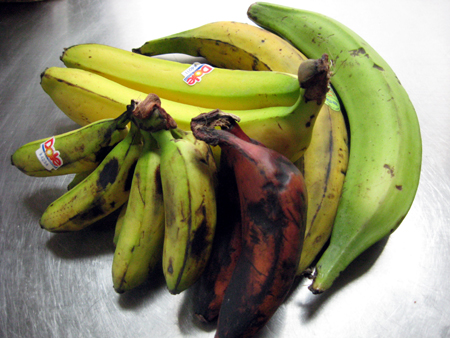
The first thing I noticed about getting the bananas was how much attention they garnered. The guy in the produce department told me that he liked the red bananas because as they ripen they get very sweet; he likes to wait until they’re quite soft and extremely sweet. He hadn’t tried the Ninos, but warned me that they tend to stay green, stay green, stay green, and then all of a sudden go bad over the course of a couple of days. He asked me how I would use the plantains.
The cashier who rang up my order was curious about the bananas, but more concerned with their potassium content than their flavor. She told me about how potassium is extremely important for women, especially during their menstruation as they lose many nutrients when they bleed. Not the average grocery store checkout conversation, and just because I got some different-looking bananas.
The next thing I noticed about the bananas was something that Dan Koeppel mentions in Bananas as a key reason why most banana cultivars aren’t seen in stores: their skin is much thinner than the Cavendish, and therefore much more likely to bruise. The bruises that developed on the Red and Nino bananas were a bit of an obstacle for me to overcome; I generally am overprotective of my bananas, to the point that I hover by the grocery checkout bagging conveyor belt to make certain that they don’t hit the bump at the end of it and get bruised through mishandling upon purchase; and if I travel with a banana I’m apt to carry it in my banana bunker, a clever contraption I received for Christmas from my brother a couple of years back that encases the banana in a shield of plastic.
Once I came to terms with the fact that the flesh of these bananas would be softer than the Cavendish flesh that I’m accustomed to, I found exactly what Koeppel describes: the bananas are significantly more flavorful than a Cavendish: much sweeter, somewhat similar to (but not exactly) the flavor you’d expect of a Cavendish when it’s so soft the only thing you can do with it is make a cream pie or a lopaf of bread, but while the flesh is still much firmer than that.
As far as the plantains go, they are a starchy banana, a cooking banana, not a banana that you peel and eat out of hand.
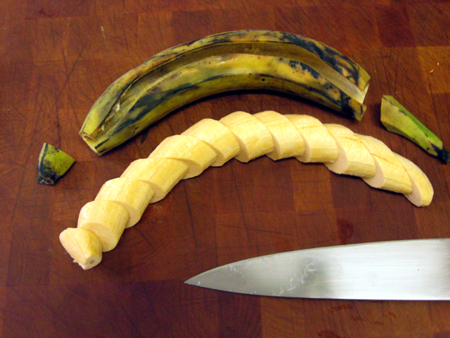
I have eaten plantain chips before, and am a big fan, but I have never tried cooking plantains myself, so I turned to sources who have for guidance. They recommended slicing the plantains down into medallions, pan frying them, removing them from the oil and mashing them down, dunking them in salt water, and pan frying a second time. According to these instructions, the plantains shouldn’t splatter when you return them to the oil for their second frying because they absorb the water.
I followed the directions as best I could, slicing the plantains into even, approximately 3/4-inch slices, but I let them go a bit long in the oil, and so when I did the second fry, they went beyond caramelized and into the realm of being burnt:
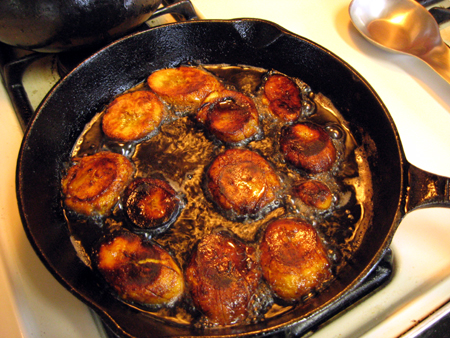
Also, when i put them in the oil for their second frying, they did splatter quite a bit. I think that problem would probably be corrected by letting them sit briefly after dunking them in the salt water instead of returning them immediately to the pan. I look forward to experimenting more with plantains in the months and years to come. If I ever get to the point where I feel like I understand how to cook them really well, I’ll post some instructions. In the meantime, if you’re more experienced with plantains and have some tips that you could share with me for handling them more efficiently, I would be very appreciative of your assistance.
March 26th, 2008 at 4:27 am
In case you are hungry for bananas on the go (and happen to be on Pittsburgh’s North Side) . . . may I suggest Hoi Polloi’s “Grilled Banana and Nutella Sandwich?” I ate there recently, and this sandwich ended up being the dessert, and I loved it (and I’m not normally even a fan of Nutella). The food here is awesome, mostly organic, and vegetarian friendly.
Hoi Polloi Vegetarian Cafe & Coffeehouse
(412) 586-4567
North Side
1100 Galveston Ave
Pittsburgh, PA 15233
More info here . . . http://www.urbanspoon.com/r/23/334615/Pittsburgh/North-Side-restaurants/Hoi-Polloi-Vegetarian-Cafe-Coffeehouse.html
March 30th, 2008 at 10:20 am
I just thought you might be interested in the ecological threats to the banana….especially the Cavendish. Basically, because bananas are so favorable, we have “domesticated” them into a seedless, sterile fruit that lacks genetic diversity…or ny way of increasing diversity (lack of seeds). Therefore, all bananas that yo find in the store are more or less genetically identical and therefore are subject to the same threats such as fungal diseases. The problem is that they have lost the ability to adapt or evolve resistance to these diseases since they lack genetic diversity. This is actually a major problem as many developing nations depend on the banana as a staple food. The problem is very similar to that of the potato famine that took place in Ireland. There are scientists working to preserve geteically different strains by way of genetic engineering. However, many large distributors think that people (consumers of 1st world countries) will be turned off by the thought of genetic engineering. Anyhow, there is a whole host of info you can read off the internet.
Here is one site: http://www.popsci.com/scitech/article/2005-06/can-fruit-be-saved
April 2nd, 2008 at 4:53 pm
Plantains I know.
The key thing to remember is that “plantains” can mean “green plantains” or “ripe plantains”. Green plantains (the whole thing should still be green) are starchy; you can do pretty much the same things with them that you do with potatoes. The procedure you followed is one for green plantains–compare it to the procedure for french fries from scratch. Ripe plantains are the one I prefer; they are quite sweet. (Yours is in between–ripe plantains will start to spot like very ripe bananas; they are firmer than bananas, so they can turn almost black before starting to spoil.) Really ripe plantains are sweet, and so they burn easily; if you have ever fried cooked sweet potato slices, it’s almost the same procedure. They need to cook over low heat (I’d say about the same as for scones–cooler than pancakes and hotter than eggs).
April 2nd, 2008 at 6:09 pm
That explains it— My plantain was definitely in the yellow stage when I sliced it down and cooked it. Thanks for the tip.
July 12th, 2008 at 8:39 pm
Further reading on bananas . . .
http://www.ethicurean.com/2008/06/25/the-slippery-slope-of-banana-disasters/
September 28th, 2008 at 11:21 am
Hi…came across your site today. Very nice and informative. I am no classically trained chef, but I think you folks who are, and care about food, rule.
Plantains. Let me out myself right away. My family owns the Chifles Plantain Chip factory in Tampa, FL. I know a little about plantains. I am also from a Latino family (father was from Ecuador), and I spent a number of years in Cuba and other Central and South American countries. Living in Tampa, with my family background, yeah, I was raised on this cuisine. Keep in mind other cultures and countries have different ways of making these dishes; these are the ones I know.
Sooo….for the green plantains, making the chips. Best way is a mandoline, slice thin into deep fat fryer with peanut oil or a similar oil with a high flash point, when golden, drain and salt immediately. The fried green plantain retains so much less oil, you need to salt it right away or the salt wont stick at all.
You can cut the green ones thicker for patacones. What you have in the picture above is about the right thickness for patacones. Place into a skillet with enough oil to do just as you have above; not quite cover them. Cook on med-med high heat for about 2-3 minutes on each side, take them out, drain on paper towels, then take a flat bottomed glass, a mallet, or anything with a round flat surface, give it a good whack to flatten somewhat, put back into the oil, cook again on each side to your shade of golden goodness, salt and eat immediately. We eat them for breakfast a lot. Or, they are yummy dipped into mojo sauce as a snack or appetizer any time. For both of the above applications, your plantain should be green, hard to the touch, and with NO yellow on the skin. There are special devices out there to flatten the plantain when making tostones.
The ripe ones. The plantain you show above is what we would call ‘pinton’, or painted with ripeness…not quite there yet. For maduros, or the sweet fried ones, no it isn’t. To make real maduros, we always wait until the skin is nearly all black, and when you gently squeeze the ripening plantain, it should feel soft. Not like really ripe banana soft, but almost like a ripe avocado. The trick to them is to get plantains from a Latino market or somewhere that knows you cannot just take a green plantain and let it ripen. That doesnt work. What you get is a black skinned plantain with a hard inside. Useless.
When you have a good source, then you can leave them out to ripen, or do like my mother used to; put them in a closed paper bag and stick them on top of the refrigerator for a few days. I tell people when your plantains are black and look like you should have thrown them out 2 days ago is usually when they are ready. YMMV.
Cooking is simple. Skillet with high smoke point oil at med-med. high, slice just like you have in the picture, or more on an angle (this is strictly personal preference), cook on either side until nice golden caramelized color, turn over, do the same, take out, drain, eat and enjoy. Try not to turn until they release naturally from the pan. If you are rewarded with a maduro that sticks to your teeth, you done good. That was always our standard, the best were the ones that stuck to your teeth. Even if they dont, a ripe fried maduro is a wonderful thing.
Sorry to drone on….hope you have better luck with cooking plantains. Dont give up.