Whaddya mean, there’s more than one type of garlic?
Yes, it’s true! Though you might only see one variety of garlic at the supermarket, there are indeed many more than that–perhaps as many as 600 different cultivars. A good description of the many types of garlic and the families that they fall into is available at http://www.gourmetgarlicgardens.com/overview.htm, but a quick (and overly simplified) break down of it is that garlic can be hardnecked or softnecked, which refers to the stalk that grows above the ground from the bulb, and can come in a variety of colors. The garlic that you usually find at the grocery store comes from the artichoke garlic subgroup. According to gourmetgarlicgardens, “Artichoke garlics are the commercial growers’ favorite because they are easier to grow and produce larger bulbs than most other garlics.”
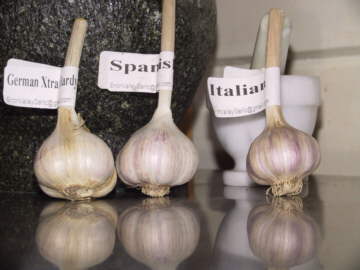
The garlics I tasted fall into two other types: Rocambole and Porcelain. The Spanish and the Italian garlics are both Rocambole. The German Extra Hardy is a Porcelain. All three had more flavor and character to them than the supermarket-garlic I compared them to.
That these garlics were something different than the garlic I was used to was apparent from their very appearance. I usually think of garlic as being monocolored: basically a uniform off-white color. These garlics, though, were rosy in hue, especially the Italian. It was mostly rose-colored, with some beige to it, and the smallest of the four cloves. The Spanish had somewhat less red on its surface, being mostly a pale, off-white with some reddish stripes to it. The German Extra Hardy was the largest of the three heirloom varieties, though considerably smaller than the supermarket garlic. It was a yellowish hue for the most part, with some pinkish stripes adorning it.
I roasted all the garlic on my Weber grill, via indirect heat, with the lid on so that it worked like an oven. To compensate for the uneven heat that is a reality of cooking on the grill, I rotated their position on the grill each time I gave them a 1/4 turn, so that each clove cooked at the same position on the grill for approximately the same time as all the other cloves. They cooked in about 20 minutes.
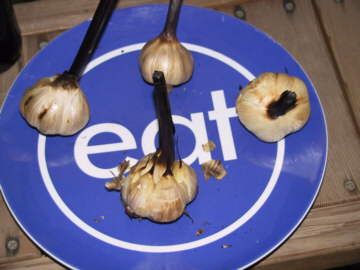
Their stems, which were rather wooden (hardnecks), became singed during the cooking process, but the cloves were roasted to perfection: soft and cooked, but not burnt nor mushy.
The German Extra Hardy was the starchiest of the garlics, and had a taste (especially when paired with grass fed Delmonico Steak from Ron Gargasz Organic Farms) quite similar to garlic mashed potatoes. It was the most bitter of the heirloom varieties, but nowhere near as bitter as the supermarket garlic. In fact, when compared only with the supermarket garlic, its taste was exceedingly mild.
The Spanish garlic was the mediumest of the garlics. It was somewhat starchy, though not to the extent of the Extra Hardy. It had a more pronounced garlic taste than the other garlics, but was not quite as smooth as the Italian. Its garlickiness was late-breaking, growing as you let the taste linger. It was also more pronounced on the outside of the clove than it was in the pulp at the center of the clove.
The Italian garlic was somewhat softer than the others. This may have been due in part to its size: it was the smallest of the three bulbs, but it was also evidently less starchy than the other garlics. Its flavor was quite smooth. Due to its consistency in the mouth and its easiness on the tongue, I believe that, mixed with a little salt and pepper, it would make a great spread for toasted baguettes or crackers.
All three of the heirloom varieties were quite a bit more pleasant to the tongue than the supermarket garlic. Its flavor began as blandness, offered a quick glimpse of garlickiness, and then finished exceedingly bitter. As the taste faded from the tongue, it remained bitter as it dwindled away.
It shouldn’t be surprising that heirloom varieties grown locally are of a higher quality than garlic mass-produced in California and shipped across the country. It’s nice to know for certain, though, that making the sustainable choice also means making the most flavorful choice. I highly recommend that you try heirloom garlic if you have the chance. These particular varieties were grown by Enon Valley Garlic and purchased at the East End Food Co-op in Pittsburgh, PA.