Archive for the 'Sustainable Food' Category

Reducing Menu Waste

Wednesday, May 23rd, 2007

You mention the menus and that they should have been updated and copies made; i can’t help but find that wasteful, although clearly the system in place at UUBU6 is inefficient in other ways. aside from a walk-up counter-style menu posted on the wall or a chalkboard with the daily specials listed, have you come across any alternative ways to present an ever-changing menu without printing a new set daily? i mean, i guess they don’t have to print 80 menus for a dining room that seats 80, so maybe it’s not as bad as i think, although any amount less waste is good to me. not to mention, i remember you used to set people straight for using paper towels unecessarily- these days, i rarely use a full paper towel for anything, and i think of you whenever i rip one into thirds. not that i ever ripped you into thirds.

–Justin

You know, I was considering similar questions as I was getting dressed this morning, before I’d even seen your comment. The best answer I could come up with for an UUBU6-specific answer was along the lines of, ‘any restaurant serving toothfish obviously isn’t too concerned about using fewer resources,’ but that’s not really a valid answer.

Posting a chalkboard/ whiteboard works in certain settings (like Frankie & Johnnie’s in New Orleans), but doesn’t quite fit expectations at an upscale establishment. Having the waiter deliver the entire menu via oral recitation makes no sense, either—there’s no way everyone at a table can catch everything and you wind up with several repetitions of, ‘wait, what else was in that thing with the shrimp?’

I think perhaps the solution most approaching practicality is to recognize that even a restaurant that changes their menu on a regular basis, be it daily, weekly, or monthly, has a somewhat stable rotation of dishes that make regular appearances. Therefore, restaurants could print the dishes and descriptions on index cards that would slide into clips on the menu holder. Each dish could be swapped out individually and the cards could be saved for future use the next time that dish makes an appearance. Updating the menu might take slightly more manpower than it currently does; but when the waitstaff meets for lineup, they could form an assembly line, with each individual responsible for replacing a single card at a time.

As far as infrastructure concerns go (the cost of producing holders for these index cards), photo albums are already mass produced and available cheaply. They would be perfectly suited to this proposition.

Poisoning the Bees?

Friday, May 18th, 2007

There’s a possibility that the mysterious bee deaths may be linked to the tainted pet food. To recap the individual stories, many bees have been dying mysteriously, which is a troubling development because if the bees die, who’s going to pollinate the flowers; and if the flowers aren’t pollinated, how will our crops grow? Meanwhile, pets have been getting sick, and in some cases dying because a Chinese pet food manufacturer included melamine in with its wares in an effort to make the protein content of the pet food appear to be higher than it actually was.

The intersection: the bees may be dying because their feed has perhaps been tainted, too. From the front page of today’s Pittsburgh Tribune-Review: http://www.pittsburghlive.com/x/pittsburghtrib/news/s_508326.html

Sometimes, a fast buck just isn’t worth its price. There’s no money to be made on a dead planet.

Notes From A Lecture by Michael Pollan

Thursday, May 10th, 2007

I saw Michael Pollan when he came to Pittsburgh on March 5 as part of the Drue Heinz Lecture series. Its one of two big lecture series in Pittsburgh and just a small part of the bonanza of cultural offerings this city has to offer.

It’s interesting that even as our communication methods change, the lecture still draws a crowd. True, the Drue Heinz Series draws speakers who are top in their field, and usually focuses on topics that are of interest to the public at large, even when most ideas are exchanged nowadays via digital transmission. Even in a hall of hundreds who had come specifically to hear this speech, a flurry of activity fluttered through the crowd when the emcee began his introduction by saying, “I’m sure all of you have by now already turned off your cell phones and pagers.” It’s a rare opportunity anymore to sit and focus your attention on an individual in the flesh, sans electronic distractions. Indeed, it’s a lot to expect of a person to entertain a crowd whose attention spans have been whittled away by modernity.

Mr. Pollan did not disappoint. He held the crowd enraptured for the length of his speech and through the allotted question and answer period. If he had remained on the stage, the audience would probably have continued to lob follow-ups to follow-ups at him well into the night.

He started the lecture by pointing out the silliness of our nation’s eating habits: as a whole, we are susceptible to diet crazes and shift our eating habits according to the most recent expert opinion. It is symptomatic, says Pollan, of a “national eating disorder.” He went on to say that the success of his most recent book, The Omnivore’s Dilemma, is yet another symptom of the same problem: there would not have been need for 450 pages on this topic at any other time or in any other culture; yet, here and now, the message is one he feels compelled to deliver.

(more…)

Nope.

Monday, May 7th, 2007

So I noticed that you occasionally mention products in your posts–most recently the kitchen-aid immersion blender. I’ve also been reading about word-of-mouth marketing campaigns where bloggers and people are paid to talk up products as if they’re the coolest shit in the world. Are you getting paid for this?

Wait—bloggers and people getting paid? Bloggers aren’t people? It’s not like when I started writing this I gave up my humanity.

But, no, I’m not getting paid for any of this. No money exchanges hands for Corduroy Orange, unless you count the money I pay to my web hosting company. I mention products because I like them and I think they’re useful.

My brother’s been suggesting that I sell some ad space on the page, but I’m not sold on that idea. I can’t even stand at a urinal anymore without having an ad in my face, and I like the idea of having ad-free space.

I suppose if in some lapse of judgement a company offered me money to promote their product and it were a product that I used and liked, I would agree to the arrangement (and disclose it); but I don’t see that happening anytime soon, especially because I’m more apt to encourage people to buy less and reuse what they already have instead of running out to grab more junk that they don’t really need. Not to mention that I hardly have the name recognition advertisers seek when they dole out sponsorship dollars.

Still, though, I see some people hawking their things on TV and I have no idea who they are: like that guy who’s been promoting his new menu items at Applebee’s—I’d never seen him before his mug showed up on that ad. And that’s hardly a great first impression: the guy who schleps his stuff for a national chain with so few distinguishing characteristics that it could be any one of several similarly blah establishments. I suppose he’s getting paid pretty well for it, but I’ve got a tough time taking anyone seriously as a “celebrity chef” who obviously has no integrity about the source of their ingredients or the quality of their product.

So, to make a short story long, I don’t really have interest in pursuing advertising dollars. I’d much rather be well connected to the sources of food near me; to know the farmers and where my food comes from; and to encourage others to do the same. I’d much rather see the national conglomomarket fade and be replaced with many overlapping local networks of people connected to the land around them, the natural flux of seasons, and the way food ought to be grown and raised.

So You Want To Roast A Pig?

Wednesday, May 2nd, 2007

I had this crazy idea to have a pig roast in the next month or so, after watching the Indonesia episode of No Reservations. I want to get a whole pig, fill it with herbs, and throw it on a spit in my yard. The first question is, how should I go about procuring a pig? I found this one place:
http://www.wildenfamilyfarms.com/Main/product.html

It looks like it will run about $230 for a 170lb pig. Any ideas for other places or is that a good price from a reputable place? The next piece of the problem is getting the thing gutted. The place above charges $110 for that. How hard is something like that to do myself?

Do you have any other suggestions for things I might be missing?

Thanks,
serge

Serge—

First off, wherever you decide to get the pig, pay them to gut it. It’ll be so much easier, and you won’t have to worry about entrails and noxious odors.

I’m familiar with Wilden Farms, and you’ll get a good product from them. A couple of other Pennsylvania farms offering responsibly raised pork are Mickley Organic Farms, 724.530.2207 and Heilman Family Farm, 724.353.1411. I’m not sure what sort of price they would offer for a whole animal, but it’s probably worth checking.

I’ve never actually roasted a whole pig on a spit. At one of the restaurants where I worked, there was a party that requested three whole pigs that the chef didn’t get in the oven soon enough and then had to turn the heat up on to get them cooked in time. The result was good, but not as good as it would have been if he’d done them properly, for a longer time at a lower heat. But that was in the oven, and I doubt if your oven would fit the whole animal (I know mine probably wouldn’t).

There’s a danger to cooking the pig for too long, though. When my dad was in the Navy, one of his superior officers held a pig roast for his whole unit. The guy in charge of cooking the pig claimed he knew what he was doing, dug a hole in the ground, built a fire, added the pig wrapped in a wet burlap sack (he wanted banana leaves, but they weren’t available), covered it up, and said that it would be perfect the next day. The next day came and everyone showed up at the party (where the side of the garage was obscured by cases of Pabst Blue Ribbon stacked it’s entire length and height). They dug the hole open to find nothing but ashes.

I’m not sure where they were getting their pigs from (I was a long time away from existing at this point), but somehow they ran out and procured another one (maybe the base got pigs in whole?) and started the process again. Trouble was, the house wasn’t on the base, it was in civilian-land, where the neighbors aren’t big fans of a yard full of Pabst-drunk sailors making a ruckus. The cops showed up and told them they had two choices: go inside (the small bungalow-type cottage) or disperse. Everyone knew the second they started their vehicle they;d be in for a DUI, so they all crammed into the cottage. The pig was nowhere near done and everyone was getting hungry, so they ate rare pig. No one got arrested and no one got sick, so there could’ve been worse outcomes to the day.

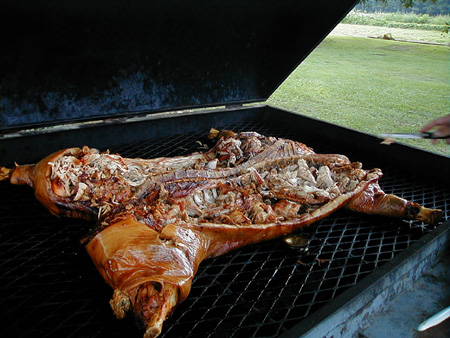
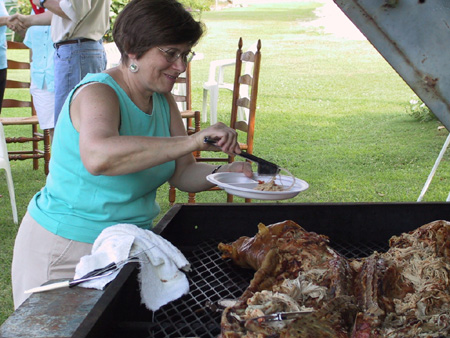
As far as successful pig roasts go, my mom’s family has occasional pig pickin’s that sound like lots of fun, but unfortunately I was never in North Carolina at the same time one was being held. They roast a whole pig, but not on a spit: on a grill made from a converted oil tank.

They flay the pig out and roast it slowly–starting it in the morning so it’ll be done by dinner.

When it gets to be almost done, they dress it with a vinegar-based sauce.

Finally, it’s ready: real pulled pork barbecue.

One thing that you might watch out for when you do roast the pig is the rendered fat: so long as the skin is whole, it’ll contain the fat. But once you cut into the skin, that opens a path for the hot fat to travel; if the pig’s over the fire, that could lead to some insanely large flames.

Not that any of that is much help toward your real question, how to roast a pig on a spit, the short answer to which would be, I don’t know. Here’s some advice from some folks who do know, though, complete with some bitchin’ photos to guide your work.

Good luck! I hope it comes out well.

Photo credit: Jim Sharrard

The FDA Knew About Problems

Tuesday, April 24th, 2007

But Didn’t Act Due to Budget Constraints

According to published reports, the FDA knew for “years” about the problems at the peanut butter plant in Georgia and about the farms in California that produced tainted spinach, but didn’t do anything to stop the situations, instead relying on the industry to self-police.

I’m not quite sure what’s more frustrating: that the FDA seems to make so many of its decisions based on the desires of industry lobbyists, or that the FDA would still rely on the industry to self-correct even with evidence of ongoing problems. If there’s one thing that’s abundantly clear to me, it’s that in most cases, most industries place profits at a higher priority than public safety issues. That’s the whole reason behind having a government agency to regulate the industries. What’s the point of having the agency if all it does is sit back and say, “OK, guys, looks like you’ve got everything under control; just keep doing what you’re doing…”?

I’d say give ‘em some teeth, but with their schematics being what they currently are, they’d probably use the teeth to make things tougher on the small, local farmer who’s trying to distribute regionally. Instead, I think it’d be a better idea to dramatically reorganize to place emphasis on encouraging regional distribution whilst deemphasizing national mono-cropped conglomofarming.

Put the burden on the largest farms to prove that their practices aren’t disturbing the environment and/or putting consumers at risk. Reward smaller farmers who plant a variety of crops and rotate them properly.

We’ve spent too long looking at the system and saying, “It’s broken, but we can’t fix it.” Heck, that’s what the FDA did with the spinach and the peanut butter. Unless we make changes soon, the worst is yet to come because our food is being produced in unnatural ways that, over time, lead to compounded safety concerns. I fear we’re on the crest of seeing the results of decades’ worth of compounding.

Other people see it, too. Why else would “Buy Fresh, Buy Local” make it on the cover of Time Magazine? It’s because there’s a groundswell of people saying the exact same thing I do: doped-up livestock shitting directly into the rivers and acres of corn / soy / tomatoes in soil stripped of its natural nutrients, propped up by even more chemical enhancers does not add up to a desireable situation.

It’s time for the government to recognize that the industry isn’t looking out for the people, it’s looking out for itself; to recognize that a populace raised on corn and chemicals is not a healthy one; and to overhaul the system for the benefit of everyone who eats, in favor of more sustainably raised food from smaller farms, distributed across a smaller swath of the land.

Poached Egg Problem

Saturday, April 21st, 2007

Corduroy—
Is it possible to get salmonella poisoning from poached eggs?

Yes, similarly to how it’s possible to get salmonella from sunny-side-up eggs. The runny yolk is sign that the proteins in the egg have not all coagulated, and therefore a sign that bacteria present in the egg may have survived. If the white is still runny, the egg has reached a lower temperature, and the possibility of food bore illness is therefore greater.

Most food pathologist type people will therefore urge you to eat your eggs “fully cooked”—with not even a hint of liquidity to the yolk. Unless my egg is boiled or going on a sandwich, though, I can’t play that game: the rubbery texture of an overdone egg is downright undesirable.

This is why the freshness of your eggs is of paramount importance. The fresher the egg, the more probable that its bacterial levels are not harmful. Most eggs purchased from a grocery store are probably about four weeks old by the time you get them. If you’ve held onto them for another couple of weeks, it’s probably time to hard boil them and get some fresher eggs for your less-cooked purposes.

Or, search out farms in your area and see if you can get eggs straight from the farm. Chances are they’ll cost somewhere in the range of $2-$3 per dozen, but the somewhat higher price tag is justified in terms of freshness, better treatment of the animals (visit the farm if you can and see how the chickens live, otherwise, ask questions), and flavor. Indeed, the difference between farm and factory eggs is quickly seen, even before it is tasted.

Raw Milk

Tuesday, April 3rd, 2007

jesse - I’d love to hear any thoughts you have about the miracle health benefits of raw (unpasturized) milk. apparently it can cure eczema, asthma, and even hep c. I can’t get it in NJ (until I cultivate some black market raw milk farmers) so might be planning a raw milk pit stop on my next trip to albany and/or pgh.

(http://www.realmilk.com/where.html)

Kari–

All of my propoganda on raw milk comes from the same source as yours does, the folks at the Weston A. Price Foundation, who sponsor the Real Milk campaign. I gathered up some of their literature and attended a lecture they organized about the benefits of raw milk at the Pittsburgh “Farm to Table” conference on Saturday.

The organization is dedicated to propogating the beliefs of Weston A. Price, who, in the 1930s, “traveled to isolated parts of the globe to study the health of populations untouched by western civilization” and decided, based on his observations, that these civilizations enjoyed better health (namely dental) than most westerners and that their diet was the reason behind this situation.

(more…)

Dining Sustainably

Sunday, April 1st, 2007

Yesterday I went to the Pittsburgh Farm to Table conference and met a lot of great farmers who are doing some really cool stuff, and I’m sure I’ll be writing more about that in the next couple of days.  For now, I want to look at an area that doesn’t often get much mention in conversations about food, and that’s the accoutrements with which our food is served.

How often do you clean up from a meal by simply throwing everything away? Cup, plate, flatware, napkin(s), all away in the trash? How about partway–cup and napkin? Napkin and plate? Napkin? How much do you throw away in a week?

It’s an emerging trend that people carry their own cups with them so they can avoid wasting fifteen-odd foam or paper cups in a week, and I think that’s great. I wish everyone carried a cup everywhere with them, and if you’re not already doing it, I recommend you start.

But I don’t think that people should stop there. It’s incredible how many paper napkins a person can go through in a week, and just as incredible how few you can go through if you carry a cloth napkin everyhwere you go.

(more…)

Easter Dinner At the Sharrard House

Friday, March 30th, 2007

On another note, I was wondering if you have a menu planned for Easter (I am assuming you celebrate it since you posted about the King Cake a little bit ago, if you don’t just disregard this). I would love to see it, as I feel I am missing something in mine. It is the first holiday my husband and I have had a chance to host so I really don’t want to ruin it.

Easter is one of my favorite dinners of the year. Every year since I can remember, I’ve had absolutely wonderful North Carolina ham (with some side dishes, of course). For the past several years, my parents have been generous enough to order a ham for me when they get one for themselves, a gesture I always appreciate, becuase if they ever stopped ordering it, I’d be forced to spend my own money to get one as I can’t imagine Easter dinner without one.

North Carolina ham is salt cured, with no water injected. It’s quite a bit drier and saltier than supermarket hams, but it’s also quite a bit higher quality. My Uncle Luther used to raise hogs in Meadow, NC. We were always lucky when he sent us one of his hams. I don’t think he ever heard the phrase “free range,” and if he did, I doubt he’d have used it; but that’s how he raised his hogs because that’s what made sense. A pig tastes better when it gets exercise, so he gave them a limited run of the land, allowing them to swim in his irrigation ponds and run through the woods. I was always a bit scared of them when we went fishing in the ponds with our bamboo poles, but now I think it’s a wonderful way to treat your livestock. Another great technique he used was to let the hogs root through the sweet potato fields after they had been harvested and eat the tubers that hadn’t been pulled.

(more…)