Archive for the 'Cooking Tips' Category

If you’re ever contemplating eating a hound…

Monday, October 9th, 2006

Be safe in the event of extreme hunger calling for desperate measures regarding Fido’s status as a member of the family: “…the risk of trichinosis makes it imperative for hounds to be cooked thoroughly.”

Schott’s Food & Drink Miscellany. New York: Bloomsbury, 2004. page 120

Vegetable Cookery Crib Sheet

Wednesday, October 4th, 2006

Could you help me out with a cribsheet helping me figure out what order I should satuee vegetables? I was sauteeing a number of different ones for a veggie lasagna recently, and realized that I wasn’t sure what length of time each had to cook relative to the others.

In general, the length of time any particular vegetable is going to have to cook is dependent upon two factors: its size and its density. Assuming you have all of your vegetables cut to pretty much the same size, the following list is a pretty good crib sheet for what order they should be added into the pan:

    1. carrots, potatoes, beets
    2. turnips, parsnips, winter squashes
    3. onions
    4. broccoli stems, fennel
    5. garlic, peppers
    6. broccoli florettes, apples
    7. collard greens, mushrooms, swiss chard stems
    8. zucchini, summer squash, corn
    9. kale, mustard greens, cranberries, tomatoes (if they’ve been juiced and you want them to still retain some of their shape; otherwise add tomatoes as part of any liquid that goes in the dish and use them to help simmer everything else)
    10. spinach, swiss chard, arugula
      Assume a couple minutes of sauteeing (or, if applicable, roasting) time between each level if your vegetables are cut to a small dice; longer the bigger they are. I’m sure I’ve forgotten a few vegetables from the list. If I’ve neglected your favorite veg, post a comment and I’ll fit it into the list for you.

Huevos con Papas y Col Rizada

Monday, October 2nd, 2006

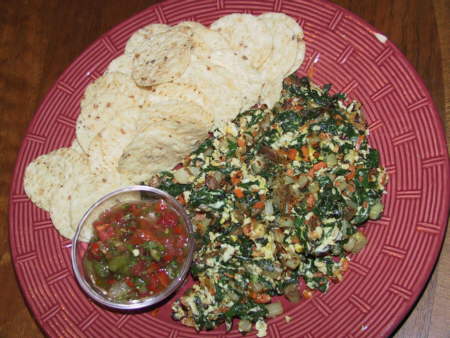
Eggs with Potatoes & KaleI don’t really have any reason to believe that this dish is of Hispanic origin; I just like the way the Spanish name sounds when you say it out loud. Especially if you know how to speak the language with a decent accent, something I’m unable to do. It’s extremely simple to make and quite tasty; an excellent breakfast or dinner. I suppose you could have it for lunch, too, if you really wanted, but most of the time it seems like lunches aren’t cooked on the stove. Probably because most of the time they’re eaten out of paper bags and contain phrases like “salad” and “sandwich” because we tend to eat them on the go; but that’s neither here nor there.

eggs with potatoes and kale

Eggs with potatoes and kale, pictured here with tortilla chips
and roasted tomatillo salsa

I remember the first time I heard of kale. I was watching re-runs of Cheers one evening while I was still in high school. Woody was spokesperson for a health drink he’d never tasted. When he finally did, he spat it out and screamed, “What’s in this stuff?”, looked at the ingredients and spluttered, “Kale! I don’t even know what kale is!”

It wasn’t for another eight or ten years that I actually tasted the stuff. It turns out that kale is a nutritious and tasty leafy green. It might not be something you’re accustomed to having in your produce drawer, but you should become familiar with it because it’s so good! Most of the time it’s braised or steamed; but I like this preparation because it incorporates the heartiness of the kale into the meal as a whole.

(more…)

Building Your Pie on a Firm Foundation

Tuesday, September 26th, 2006

How to make a tasty crust

Dedicated readers might recognize this recipe: I included it as a part of my peach and blueberry struesel pie. Upon further reflection, though, I’ve decided that it’s deserving of its own heading. There are so many other different kinds of pies that can benefit from this recipe because a homemade crust improves any pie. I’d even go so far as to say I’d rather eat a pie featuring a poorly-made crust than a high quality store crust because when you make it yourself you show how much you care.

Lots of people get scared off by the prospect of making their own crust because it has an aura of difficulty about it: whether it’s the impossibility of predicting exactly how much water you’ll need to add or the task of rolling the crust out by hand, I’m not sure. Maybe it’s a bit of both. It shouldn’t be, though. The process is surprisingly easy to learn, and the more you do it, the easier it becomes. Not only that, but the essential ingredients are all things you’re almost guaranteed to have on hand: flour, salt, butter and/or shortening, and water. That’s it. So, take on the challenge of crafting your own crust. You can even pretend it’s as difficult as people seem to think if it increases the adulations your guests shower upon your efforts.

(more…)

The Best Way to Peel Garlic

Tuesday, September 19th, 2006

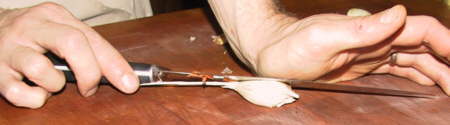
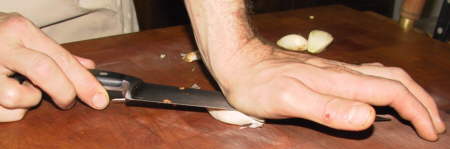
Too many people spend way too long extending and protracting the process of peeling a clove of garlic. There’s no need to roll it in a rubber sheath nor strip at it with a paring knife. Life’s too short to waste time on such unnecessary inefficiency. Three steps, five to ten seconds, your garlic is peeled.

1) Place your knife flat upon the garlic.

place your knife upon the clove

2) Press down firmly, but do not strike the blade.

press down but do not strike

3) Grasp the peel at the sprot end in one hand and the garlic at the root end with the other.

take one in one hand and the other in the other

They come apart effortlessly. If you have to peel a lot of garlic, perform each step on all cloves before proceeding to the next step. Only press down on one clove (or clove group, if a couple or three cloves are stuck together as one) at a time. If you’re trying to mash multiple groupings, none of them come apart as well or as quickly as if you were to do each separately in succession.

Also, if you need a great deal of garlic for any particular purpose (~1 bulb or more), place the bulb on your cutting board root side up and press down on it as you would to peel a single clove of garlic.  The cloves will come apart from the bulb much more quickly than if you were to try to pull them all off individually.

Defining Cooking Methods

Friday, September 15th, 2006

There are a limited number of different ways to cook your food. Everything that you can possibly make, no matter how simple or complicated, will fall within (at least) one of twelve categories, though some dishes incorporate multiple techniques.

The twelve categories can be divided into two basic groups: moist heat, and dry heat. Moist heat, as the name implies, involves cooking with water or some variation on water (stock, wine, beer, etc.). Dry heat involves non-aquatic heat transfer methods, thus, somewhat counter-intuitively, deep frying is classified as dry heat because oil, while liquid, contains no water.

(more…)

Dice Carrots with Celerity!

Thursday, September 14th, 2006

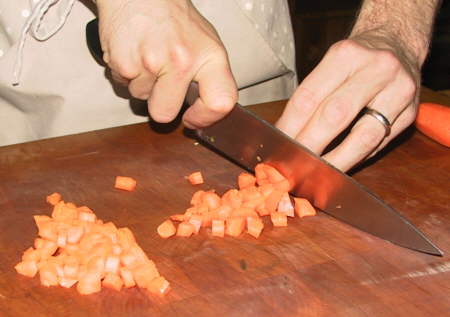
Three steps to make quick work of your roots

Most knife skills books will have you square your carrot off, slice exact planks, segment the planks into sticks, and finally cut them down to a precisely diced finish. It’s a painstaking, time-consuming process even with the sharpest of knives. The results that method yields are undeniable, and if you’ve got lots of time and exactitude of your finished vegetables is important to your presentation, it makes sense to follow the long way.

These results in less time than you think possible!

For most purposes, though, it just doesn’t make sense to labor over perfecting each orange box into exact 1/4-inch cubehood. So, why bother? Get 96% of the results while spending just 23% of the time by following these three easy steps. Your salads will look better, your stews will cook more uniformly, and you’ll get out of the kitchen sooner—it’s a win-win-win situation.

(more…)

Eating Well on the Road

Friday, September 8th, 2006

My job has me living on the road most of the year, and becasue of this I don’t always have the best eating habits. Do you have suggestions on better ways for me to follow the food pyramid while living out of a hotel room?

thanks!

hungry in ohio

HIO–

First things first, let’s forget about the food pyramid. That device was designed by a committee and it shows. Instead of concentrating on meeting the requirements poorly laid out in a jumbled chart, instead think about your diet with some common sense. Realize that your nutritional intake is tantamount to your life—-the only thing you’ve got going for you at any particular time is the sum total of what you’ve eaten lately. Because your diet is of consummate consequence, make the quality of your edibles to be of utmost importance.

(more…)

Choosing a Cutting Board

Friday, September 1st, 2006

Howdy! I have a question for you: What kind of cutting board to use? I’ve heard that using a plastic board can dull a knife more quickly than a wooden board, but isn’t plastic more resistant to bacteria than wood? Perhaps you can share your thoughts on the merits and drawbacks of each and what you recommend for folks. Also, do you have any experience with bamboo cutting boards?

At my house, I never have an issue with which cutting board to use. Thanks to my brother, and to the fact that I got married, most of the time I’m using a handsome Boos Block Maple Butcher’s Block.

butcher's blockcutting surface
I have no complaints about this cutting board. It’s well made, attractive, and useful. For those who don’t have space for the freestanding version, Boos also makes smaller cutting boards that store easily in a cupboard. Because I never cut raw meat on it, I don’t have any concerns about bacterial growth; however, just to be certain, I will occasionally wipe it down with a diluted bleach solution. Classy and durable, its only drawback is that it comes from trees. (more…)

Black Beans for 80?

Friday, September 1st, 2006

What’s the best way for me to make a massive quantity of black beans and white rice without burning the contents? At Camp EPP, I made a big batch of black beans, but burned the beans on the bottom, giving it a burny flavor. I’m anticipating around 80 for the party.

If you’re going to cook beans for that many people, you’re going to need a big pot. Heavy-bottomed, if possible. The thinner the material between the food and the flame, the easier it is for the food to scorch.

When you’re cooking indoors, though, you’ve got an advantage over cooking on a campfire: easily regulated temperature. Soak your beans overnight. Then, I’d recommend sauteeing some onions and some garlic in the bottom of your pot, along with a little pepper and whatever other spices you’re using. Then, add your liquid (3-4 cups per pound of dried beans) and your beans, and bring the mixture to a boil. Once it boils, reduce the heat and let it simmer slowly for several hours (a few small bubbles gently breaking the surface.) Adjust the heat as necessary to keep the pot at a steady simmer. Stir it regularly to keep the beans from burning to the bottom of the pan. You’ll need to stir more often as the beans get closer to finishing, because as the cooking liquid thickens, there’s less water to evaporate and the heat becomes less forgiving. If, by unfortunate chance, you do wind up having some beans scorch to the bottom of the pan, don’t scrape them off the bottom when you stir! If you leave them there, they will not have too much of an effect on the finished dish, but if you dredge them up, they will mingle with everything else, lending their bitterness to all the beans.

Have a cooking question? Email me! I’ll respond in a future post.