Archive for the 'Cast Iron' Category

Cast Iron: Buy it Used

Sunday, May 4th, 2008

I was reading through the New York Times Magazine this morning and came across their Recipe Redux feature, this week focusing on a braised chicken dish first published in 1969.  In their photographic explanation of the dish (follow the pop-up javascript graphic on the Times webpage), they say for gear, “A heavy, lidded frying pan is all you need.  Spoon out the chicken and juices directly from the pan.  This Staub 2-quart cocotte is $109.95 at kitchenclique.com.”

While a frying pan would work, a dutch oven (the dish they describe as a cocotte, a French term that in addition to referring to a baking dish also means prostitute) is probably a better bet; either way, it is ridiculous, in my view, to pay $110 plus shipping for the cooking dish when so many perfectly good (quite possibly better) examples are available from tag sales, flea markets, and antique stores for $35-$50.

These pans are designed to last generations.  With a very few exceptions (very large or specialty pans that one can rarely find in a used state), there is little or no reason to buy new.

Going Old-Fangled with My Wafflemaker

Saturday, April 26th, 2008

Most people who know me know about my obsession with cast iron—it’s sturdy (will last for generations), versatile (equally good on electric, gas, or campfire), almost as non-stick as teflon without the risk of its surface coating flaking off into your food, and economical (many fine specimens are available at antique stores and flea markets for $30 or less).

Still, when I bought my cast iron wafflemaker it was, in my mind, a curiosity piece: an unusual specimen from a bygone era. After all, I had a perfectly good wafflemaker that plugs into the wall and heats predictably, whereas the cast iron piece would have to sit on my burner and would only get heated on one side. As I purchased it, I decided it was a good thing that Aurora wasn’t with me because she probably would have vetoed the $50 price tag (even if she does on occasion talk me into buying pieces of cast iron that I’m on the fence about).

Once I got it home, I discovered how well-designed this antique actually is.

(more…)

Using Cast Iron

Monday, May 14th, 2007

I’m interested in hearing your thoughts on what situations are ideal for the cast iron approach.

For most purposes, I have a cheap 6″ skillet and a cheap 8″ skillet and I use my roomie’s really nice 10″ sautee pan for big jobs, all non-stick. But in the back of my mind, I know I’m missing the boat, eg, when I make skillet-based dishes with potatoes. The cast iron would help produce that tasty golden crust… But are there other areas where I’m missing out on having the right tool for the job?

Or in other words, *please* help me justify getting some cast iron cookware

I use my cast iron for almost everything: bacon, potatoes, stews, steaks, pork chops, etc., so I’m fairly biased; About the only thing I don’t use my cast iron for is tomato sauce: the high acidity of tomatoes is bad for the pans: it wears down the seasoning and prompts them to rust. The one big argument that I can make in favor of you trading in your cheapie non-stick for cast iron is that cast iron has most of the benefits of non-stick pans (once it’s been properly seasoned) without having the coating that flakes off and adds weird chemicals to your food.

I have a non-stick pan that I use exclusively for omelettes and try to store it in such a way that nothing comes off the bottom, but if a skillet like that is in everyday use, it’s bound to pick up nicks and scratches. I’m not exactly sure what’s in Teflon, but I know that I don’t want to eat it.

Buying Cast Iron

Sunday, May 13th, 2007

Corduroy,
I’m graduating from college and need to buy some skillets/pans. I really like cast-iron and I think you’ve mentioned Lodge as a good brand. But what size do I need? If I were to get one or two pans what is the most useful size?

Thanks,
Jill

Jill—

As far as sizes are concerned, that all depends on what you cook and how many people you’re cooking for—the more people you’re cooking for, the larger of a pan you’ll need. My biggest piece of cast iron is a 15-inch skillet. It spends most of its time hanging out in the basement, too big to be of use, but when my wife and I went to a cabin with three other couples this weekend, it was extremely handy when it came time to make hash browns, pancakes, and fried eggs (three waves of food through the pan). I doubt you’ll need anything that big, though. My guess is that you’d do just fine with an eight-inch and a ten-inch.

Lodge is a good brand, and widely available, but truth be told, you don’t really need to worry too much about brand names when it comes to cast iron. Three of my pans (the first three I bought) are Martha Stewart brand from K-Mart. They’re a bit thicker than my other skillets and heat up a bit more slowly, but they work just fine and will be a permanent part of my collection.

A good source for getting quality cast iron is Cajun Cast Iron, which is currently offering a three-piece starter set (6, 8, and 10-inch skillets) for only $9. That’s a great deal—probably less than I paid at K-Mart (though i didn’t have to pay shipping on that purchase)—especially considering that they’ve got the 10-inch by itself marked at $9. Although, when you follow the link for the 3-piece set, the price mysteriously goes up from $9 to $14.

If I were you, I’d act on it quickly before they discover the bug: call them on the phone and tell them that the front page says $9, so they really ought to be selling it to you for that price according to truth in advertising laws. Even if they adjust the price before you get there, though, the three piece starter set will get you the most commonly needed sizes at a fraction of the price of buying each separately, and the pans will still be useful when your grandchildren are dead.

Some of my favorite pans are of indeterminite brand: purchased from antique stores and flea markets and so old that the brand is obscured (or perhaps not even marked). If you’re buying used, the main thing you want to look for is rust. Superficial rust is okay, and scrapes of quickly with steel wool or a stiff wire brush, but if the rust goes deep, you’d be better off not buying it.

A couple of other favories are my Wagner Square Egg Skillet, which is (to my knowledge) only available used. It’s essential to make the perfect fried egg sandwich (the square egg fits the bread), and my dutch oven, which makes great stews, pulled pork barbecue, and popcorn. My next cast iron purchase will be a griddle that fits over two burners. Before I can get that, though, I have to convince Aurora that getting a fifteenth piece of cast iron isn’t ridiculous overkill (which shouldn’t be tough because she knows it’ll come in handy [don't you, honey?]).

You’re making a good choice getting cast iron. You’re guaranteed to get good, sturdy pans that will serve you well as long as you take care of them correctly.

Wine Sauce for Pork Roast

Monday, January 15th, 2007

I plan to make a pork “roast” that cooks in wine in the oven when my inlaws are over for dinner soon. If I wanted to use the wine and pork drippings to make a white wine sauce do I need to let it reduce anymore, or would the time in the oven be enough? I have loved the mother sauces tutorials thus far!

I fear I may have dragged my feet too long to be of assistance with your pork roast question and your in-laws may have already visited. If so, I’m sorry about that. I was hoping to try a pork roast out in my kitchen along the same lines so I could have more specific advice to give you, but sadly this hasn’t worked out; and since I’m going to be getting (in conjunction with several friends) 1/4 of a cow in the next couple days, I doubt I’ll be having pork roast anytime in the immediate future. A general (and I hope somewhat helpful) answer to your question would be that it depends on how much wine you’re using.

(more…)

The Mother Sauces, Part I

Wednesday, December 20th, 2006

The first three: Using a roux

In Classical cooking, there are five sauces that get emphasized over all others because they serve as the basis for hundreds more. These are the Mother Sauces: Bechamel, Veloute, Brown Sauce, Hollandaise, and Tomato. Sure, there are sauces (such as alfredo, beurre blanc, or a simple reduction) that fall outside of the maternal five. But, as a starting point for an accompaniment to any meal from macaroni to mutton, if you know the basic five, you’ll always be able to have a sauce to match your meal.

Because the mother sauces are such a large part of any good chef’s sauce-making potential and I want to give each sauce its due, today I’m just going to cencentrate on the first three (Bechamel, Veloute, and Brown) because these are the sauces that require a roux.

(more…)

Caring For Your Cast Iron

Monday, December 4th, 2006

I would love if you posted your cast iron seasoning and storage tips!

And I am glad to hear about the dutch oven and popcorn. Not only does the term “dutch oven” crack me up, but I have one and don’t have a popcorn maker and now I feel like the world is my popcorny oyster.

–Kari

Seasoning cast iron pans is about as painless a process as it gets, but taking the little bit of time to do it will ensure that your cast iron lasts not only for your lifetime, but your grandkids’ as well. Here’s how:
(more…)

Upgrading Your Pots and Pans

Sunday, December 3rd, 2006

Corduroy–

I’ve read your advice about knives/ what kind to buy, but really I’m more in the market for better cookware. My pots and pans are old and aluminum. I’m well aware that they aren’t an ideal set of pans, but I don’t know what I should be looking for when I go to replace them.

L.

Dear L.:

Acknowledging that you have a problem is the first step towards solving it. Simply by admitting that you have substandard pans, you’ve begun the path toward correcting the situation.

As you’ve suggested, aluminum is not a good food contact surface. Though it is light-weight and conducts heat well, it is a soft metal and corrodes quickly in the presence of acid. These two factors mean that when cooking in aluminum pans, you’re apt to wind up with trace amounts of aluminum in your meals. Some medical studies have suggested that aluminum intake may be a factor contributing toward the onset of Alzheimer’s disease. Additionally, the aluminum may discolor some foods (especially sauces) and contribute an off-flavor to your cooking. For all of these reasons, I do not cook with aluminum pans.

(more…)

Grilled Cheese and Caprese on Focaccia

Tuesday, August 29th, 2006

I can’t stand bad tomatoes. You know the ones I’m talking about: available year-round out of California, always the same quality no matter what the season. Available on salads everywhere, used simply to add color because the only favor they can contribute is somewhat rancid in nature. It’s no wonder some people don’t like tomatoes, if those are the only tomatoes they’ve been exposed to. The state of our agriculture would be improved tenfold if people didn’t have it in their fool heads that tomatoes are a right, not a privilege.

But enough of the rant, I’m no muckraker. The solution is obvious: plant a few fun varieties of tomatoes in your backyard and experience the harvest for yourself.
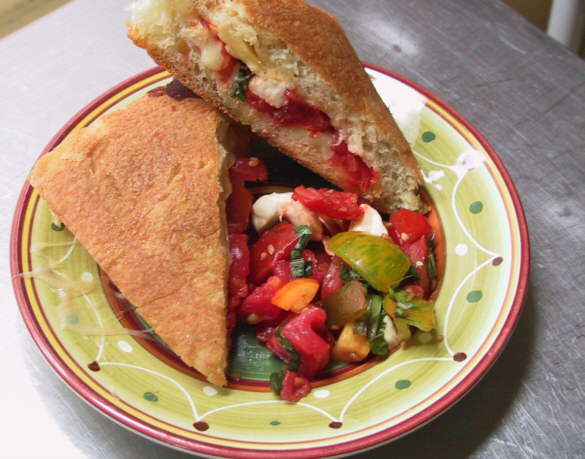
grilled cheese and caprese (more…)