Archive for the 'Recipes' Category

Quinoa [\keen'-wa\]

Friday, August 27th, 2010

Quinoa was revered by the Incas for centuries before the Spaniards invaded and forbade them from cultivating the plant they referred to (in their own language) as “the mother grain.”

I’d never done anything with quinoa until recently.  I knew of its reputation as a highly nutritious quasi-grain, the only vegetarian source of complete protein (all 9 essential amino acids in one food, as opposed to combining grains and legumes [think rice and beans]).  Recently, though, I’ve been cooking with it and I’m pleased to report that it is very tasty. Here is one great way to prepare it—enjoy!

(more…)

Roasted Vegetable Medley

Saturday, August 7th, 2010

Cut new potatoes into chunks: eights or quarters depending on the individual potato.  Halves if they’re really small.  Cut onions into one-inch chunks and peel garlic, leaving cloves whole.  Toss in bowl with oil, salt, pepper, and cayenne pepper.  Spread onto baking sheet with lip and roast at 375 F for 25-30 minutes or until potatoes are exhibiting some browning, tossing once about halfway through.

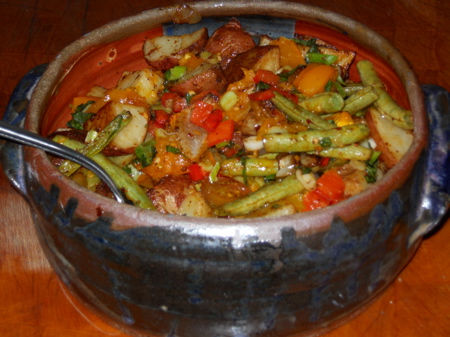
As root vegetables roast, snap stem end off of green beans and break into 1-inch pieces. Dice red bell pepper into 1/4-inch pieces (small dice).   Cut fresh heirloom tomatoes into chunks, or leave whole if using cherry tomatoes (can use mix of different size and different types of tomatoes.  As pictured, there are green zebra tomatoes, black cherry tomatoes, and yellow tomatoes (exact varietal uncertain).  Toss these vegetables in the same bowl used for the root vegetables with the same spices and another drizzle of oil.  When potatoes exhibit brownness from roasting, add these vegetables to the tray and return to the oven for 10-12 minutes.

Slice green onions and basil thinly.  Add to tray at conclusion of 10-12 minutes of roasting the beans and the onions, and return to the oven for a final 3-5 minutes.

Serve immediately in the vessel of your choice.  Liquid from the tomatoes provides a stew-like image if served in a casserole dish (as pictured above).

Pork Chop Waffle with Ramp and Rhubarb Sauce

Saturday, May 8th, 2010

I went shopping at the Farmers @ The Firehouse Market this morning to get my ingredients for my Kick Ass Cookery with Corduroy Orange live from the Waffle Shop cooking show; combined what I bought with some pickings from my garden; gathered my spices and my cooking equipment…. In short, I prepared everything I needed for today except for taking a camera to snap a picture of what I made (D’oh!).  But, here are instructions in case you’d like to have Pork Chop Waffles with Rhubarb and Ramp Sauce.

  • 1/4 pound ramps
  • 1/4 pound spring (green) garlic
  • 1/2-3/4 pound rhubarb
  • 1/2 inch fresh ginger
  • 10 leaves dinosaur kale
  • 6 leaves kohlrabi greens
  • 6 leaves red mustard greens
  • 1-2 tablespoons all purpose flour
  • 4-6 ounces apple cider (I used Woodchuck brand hard cider)
  • 4-6 ounces vegetable stock
  • 1 pork chop
  • kosher salt
  • pepper (I used a mix of black, white, green, and aleppo peppers)
  • powdered ginger
  • cardamom

Cut the green, leafy tops of the ramps and the spring garlic away from their denser bottom sections.  Set the tops aside for later and cut the bottoms into a fine dice.

Start the diced garlic and ramp bottoms caramelizing in a hot pan with a bit of oil (enough to cover the bottom of the pan), some pepper, some ginger, and some kosher salt.  Stir frequently so that the onions’ natural sugars toast in the hot oil but do not scorch and burn.

Meanwhile, cut the rhubarb into 1/2-inch chunks and add them to the pan as the garlic and ramps approach the point when, should you caramelize them further, they would run the risk of burning.  Provide the rhubarb with a very small pinch of salt and stir it in with the ramps and garlic.

Remove the stems from the kale and the kohlrabi.  Cut the greens into thin ribbons, and add them to the pan.  Saute them briefly, then add the flour and stir the flour in to combine with the oil that the vegetables are sauteing in.  Once you have formed a roux around the vegetables, add the cider, slowly, and stir it in to combine with the roux.  Let simmer for a few minutes, and adjust the consistency of the sauce with vegetable stock as necessary.

For the pork chop, craft a spice mix from the spices and the kosher salt.  Use as much pepper as you would like to reach your tolerance for spiciness.  Temper with ginger, equivalent to perhaps 1/3 of the pepper you have used.  Stir in a pinch of cardamom—a little dab’ll do you!  This spice is bitter in large quantities—and enough salt to balance the spices.  Taste the result.  Adjust as needed until you have the taste you desire.   Rub this mix on the pork chop and then sear the chop in a hot cast iron pan (in order to get the sauce and the chop done at the same time, sear the chop at about the same time as you’re crafting the roux to make the sauce.  It helps to have an assistant in order to accomplish both tasks simultaneously).

Once the one side has seared, turn the chop over and cover your cast iron pan with the saute pan that you have made the sauce in.  This will help keep the finished sauce warm whilst (and at the same time as) trapping more heat around the pork chop to help it cook all the way through.

As the second side of the pork chop cooks, slice a few inches of rhubarb into very thin pieces and stir it into the sauce to add a second, fresher and tarter layer of rhubarb flavor.  Slice the mustard greens and the tops of the ramps and green garlic into thin ribbons to use as a garnish.

Flip the pork chop once more to reheat the first side and prod the pork chop with your fingers to make sure it feels done.  If you;re in doubt, feel free to slice it open to check out the inside.  An appropriately cooked pork chop will still have a pale pink hue to the center.

Serve the pork chop atop a freshly cooked waffle.  Spoon a line of the rhubarb and ramp sauce across the waffle such that it covers a corner of the pork chop, leaving at least half of the chop exposed to display the crust that has developed from searing the spice rub.  Top it all off with a small pile of the thinly-sliced mustard, ramp, and garlic greens.

Meat and produce used for the creation of this waffle was purchased from the following farms:

  • Mott Family Farm
  • Next Life Farm
  • Goose Creek Gardens, Ltd.
  • Heilman’s Hog Wash Farms
  • The Allegheny Mushroom Man

Find all of these farmers and more every Saturday at the Farmers @ The Firehouse market in the Strip District.

Thanks also to Sophia for appearing on camera today.  Unless that thanks should go to Sofia.  I’m actually not quite sure how she spells her name….
Roasted Red Pepper Lime-Aigrette

Monday, April 5th, 2010

This salad dressing uses lime juice instead of vinegar to provide its acid.  Roasting the limes alongside the red peppers helps them to yield all of their juice.

  • 2 red bell peppers
  • 2 limes
  • The leaves from a 3.5-inch sprig of fresh rosemary, minced
  • Extra virgin olive oil equal to the limes’ juice (~1/3 cup)
  • ~1/4 teaspoon of salt (or to taste)

To roast the red peppers and the limes, get a cast iron skillet large enough to accommodate all 4 pieces hot on a medium-high flame.  Put the peppers and limes down on the hot skillet.  Keep a loose eye on them and turn them whenever their skin gets scorched–the limes will likely need to be turned sooner than the peppers.  Turn, turn, turn (to everything there is a season, turn, turn, turn) until their skin is dark and puckered on all sides of the pepper, and the limes have four scorch marks and have softened considerably.

Cut the limes in half and juice them.  Measure the juice that they yield, as this will influence how much olive oil you need.  Run the peppers under a slow trickle of cool water and pull the skin from the meat.  Discard the skin; cut the meat of the peppers from the seeds, stems, and ribs of pith.  Cut the peppers into approximately 2-inch chunks.

Combine the peppers, the lime juice, the salt, and the rosemary in a blender and puree.  With the blender running, slowly drizzle the olive oil into the pepper-lime juice mixture.  The blender will help to create a strong emulsion between the oil and the pepper puree.  this dressing should keep well without having to be shaken before each use… but it contains no preservatives except for the acid in the lime juice, so don’t let it languish forgotten in the rear of your refrigerator!  [Although, as good as it tastes, I doubt that using it up quickly will be an issue!]

Red Wine & Cherry Sauce for Lamb or Venison

Monday, March 29th, 2010

Since I seem to be on a sauces kick lately, I thought I’d stay on the same theme and recount a fantastic red wine and cherry sauce I recently made.  I served it with roast lamb, but it would go just as well with venison

  • 3 cloves garlic, sliced thinly
  • 1 red pepper, cut to small dice
  • 6-8 ounces mushrooms, sliced
  • 1/4 cup oil or butter
  • approximately 2 tablespoons flour
  • salt and pepper to taste
  • 1 cup red wine
  • 1 1/2 cups 100% cherry juice

Add the oil or butter to a hot, large saute pan with a healthy pinch of pepper.  Saute the garlic and red pepper in the seasoned oil with a small pinch (~1/4 tsp) salt.  As the pepper softens and the garlic starts to brown, add the mushrooms with another, similarly sized pinch of salt.  Stirring constantly, saute until the mushrooms have cooked down and released the oil that they absorbed when they began cooking.  If necessary, cook the mushrooms in batches to avoid overcrowding the pan.

Returning all vegetables to the pan, stir flour into the cooked vegetables.  Once the flour has formed a roux with the cooking oil, stir in red wine, gradually.  Once the red wine has been fully absorbed into the roux, stir the cherry juice in, again gradually.  Let simmer approximately 20 minutes, stirring regularly and adjusting the consistency of the sauce, if necessary, by adding a small amount of cherry juice as the sauce gets too thick.

Serve atop grilled or roasted lamb or venison.

Homemade Hot Sauce, Take 1

Sunday, March 28th, 2010

This is my first stab at creating a hot sauce, and I will be tweaking the formula in subsequent batches, but the results were good enough to merit sharing.  This sauce takes a long time to simmer, and its yield is low because of the intense reduction—but as a result, it is packed with flavor!  The first taste is sweet and the heat kicks in quickly thereafter.

  • 3 jalapeno peppers
  • 2 habanero peppers
  • 1 serrano pepper
  • 1 inch fresh ginger
  • 6 garlic cloves
  • small drizzle of olive oil
  • 1 teaspoon salt
  • 3 tablespoons paprika
  • 2/3 cup white wine
  • 3 cups vegetable sauce
  • 1/2 cup vinegar

Cut the vegetables into rough chunks.  Saute lightly with salt and paprika (which mainly serves as a coloring agent) in a trace amount of olive oil, about 2 minutes or until vegetables just start to soften.  Add white wine, bring to a boil and reduce by 2/3.

Add the vegetable stock and bring to a boil.  Reduce to a simmer and let the liquid reduce until the pan is almost dry.  How long this will take will depend on many factors, including what size pan you are using and exactly how high your heat is.  Keep a loose eye on it, stirring occasionally, and reduce the heat as the pan approaches dryness; keeping a closer eye on the situation the less liquid remains.

Add the vinegar to the reduction, bring to a boil and let boil for about 30 seconds to a minute.  Strain through cheesecloth, squeezing the cheesecloth to extract as much juice as you can.

Yield: just over 1/2 cup highly flavorful sauce.

Mac and Cheese and More!

Tuesday, March 23rd, 2010

You can use the same basic technique employed to create the garlic sauce for the Coliflor al Ajillo to create a fantastic mac and cheese with sauteed vegetables from scratch.

* 1 pound pasta (elbow macaroni for a classic look–but consider rotini: its spirals really cling to the sauce!)
* approx. 1/4 cup cooking oil
* 1 small onion, diced
* 6 cloves garlic, sliced thinly
* 1-2 cups broccoli, chopped finely
* 1 red bell pepper, diced
* 1 jalapeño pepper, ribs and seeds removed, cut to very fine dice
* approx 1/4 cup flour
* 2 cups milk
* 1/2 pound cheese, shredded (cheddar is great. So is cahill porter. For a blue cheese sauce, try 1/3 of weight in gorgonzola and the remainder in cheddar)
* salt and pepper to taste
* about 1/4 teaspoon allspice
* 1 tablespoon minced fresh rosemary (optional–but great if you’ve got it!)

Put cooking oil in large, hot sauté pan. Add pepper and rosemary to the cooking oil to infuse it (and the final product) with their flavor.

Add onion and garlic to the pan with about 1/4 teaspoon salt. Cook, stirring frequently, until they start to brown at the edges. Add broccoli with a tiny pinch of salt, cook for !out 2-3 minutes; then add peppers (bell and jalapeño) with another tiny salt infusion.

Stir flour into vegetables so that it combines with oil to make a roux (add just a tiny bit more oil if necessary) and once a roux has formed, stir the milk in gradually so that all roux is incorporated.

Let simmer forabout 15-20 minutes. When sauce is approaching doneness, cook pasta (about 5-6 min. For elbow mac, closer to 9-11 for rotini).

Just prior to draining pasta, stir the cheese into the sauce gradually so that all cheese melts and is incorporated. Thin the sauce with a tiny bit of pasta cooking water if necessary.

Drain pasta and combine with completed sauce. Serves 4-6.

Coliflor y Pimientos Al Ajillo

Friday, March 19th, 2010

This Spanish-style dish is a great variation on roasted cauliflower!

  • 1/2 head cauliflower, cut into florettes
  • 1 red bell pepper, cut into a small dice
  • 12 cloves garlic, thinly sliced
  • 1 - 1.5 tablespoons flour
  • the juice of 1 lime
  • water or vegetable stock
  • salt and pepper to taste

Toss the cauliflower with olive oil; put on a baking sheet with a lip and roast at 375 F for 17-20 minutes, depending on how large you cut the florettes.

Meanwhile, saute the garlic and red pepper in about 3 tablespoons of oil with a touch of salt and pepper.  As the garlic starts to soften and show the slightest hint of brown, stir in the flour.  The result should be a roux with the consistency of wet sand.  Add more oil if necessary.  After the roux has a chance to cook for a minute or two–or whenever you fear that the garlic may be getting too dark, whichever comes first–Whisk in the lime juice, and then the water or vegetable stock to form the sauce.  You’ll likely need about 1.5 - 2 cups total liquid.  Let simmer for about 15 minutes.  The sauce should be thick enough to coat the back of a spoon.  You can always thin the sauce out if it starts getting too thick by adding more liquid, but the only way to thicken it up if you add too much liquid is to let it simmer longer (do not add more flour once the sauce has started to simmer!).

To serve, toss the roasted cauliflower with the completed sauce and put on a platter for family-style service.

Fantastic Coffee Bitters

Friday, March 12th, 2010

I’ve read how Angostura and other bitters are in short supply.  Should bitters be an indispensable part of your bar stock, it’s quite easy to make your own.  The process is simple: put spices and herbs in neutral spirit.  Let marinate until done.  Strain.

The coffee bitters I’m providing a recipe for are pretty good–especially in an old-fashioned.  They bring a lot of flavor to the table.

Coffee Bitters:

In 2 cups of neutral spirit (vodka or grain alcohol), marinate (in a clean jelly jar with a tight-fitting lid) 1 1/2 tablespoons whole coffee beans and 1/4 teaspoon black peppercorns.  Let sit 8 days.  Add 1 cinnamon stick and 2 whole allspice berries.  Let sit another 2 weeks.  Strain, and store in same glass jar with tight-fitting lid.

Sugar On Snow

Thursday, February 18th, 2010

We’ve gotten a lot of snow in Pittsburgh lately.  It’s gummed up local roads and is starting to turn brown in places, but since more snow keeps falling, much of it still has at least a veneer of white.  As I look out the window onto snow-covered streets, my mind turns to Sugar On Snow, a food I wish I had made on the weekend of February 6, when we were getting hit with 20 inches of white powder.

The dish starts with a pot of newly fallen snow, straight from the sky.  Onto that, one pours puddles of hot (pure) maple syrup.  When the hot syrup contacts the cold snow, it hardens into a kind of taffy that is sweet and gooey.  After eating several puddles of syrup, one may find enjoyment in the saltiness of a dill pickle, which should cleanse the palate in preparation for another round of sugar.

Sure, one could always make this with shaved ice…but (a) I don’t have an ice shaver and (b) it’s not quite as fun.  But then again (c) there’s no more major snow falling [I hope] so, as a result, (d) I’m sitting here thinking and wishing instead of making and eating.

Oh well.  Next time, I’ll try to remember this and collect the snow while it’s still falling and have myself a tasty little sugar explosion.