Archive for the 'Advice Column' Category

Cafeteria Glove Choice

Thursday, September 20th, 2007

Hi! I’m a dietary sciences student at the High School of Commerce, and i was wondering why cafeterias use clear gloves to serve food items? What wrong with white gloves?

Actually, it’s what they’re made out of.  The clear gloves are vinyl and the white gloves are latex.  While not as common an allergy as peanuts, there are a certain number of people who react to latex, even if it’s the miniscule amount of the natural rubber that results from food’s momentary contact with a glove.  In order to eliminate the risk, most dining facilities have switched to vinyl gloves.

Have a question about the world of food?  Email me, and I’ll try to respond in a future post.

The Orange Scale

Friday, June 29th, 2007

Out of how many oranges does your scale go to? After searching some of your other reviews, it seems like four oranges might be the highest on the scale?

That is correct, sir. I always feel like there’s some sort of inflation going on when a scale is out of 5 stars/ oranges/ kumquats, etc. because the obvious reference for any such scale is the 4-star movie review scale. Then, I see something got four stars and I think it must be superb but it turns out that the fifth star would have indicated superbity.

My wife points out that Michelin and AAA operate on five stars. Their rating systems, though, pay as much attention to luxuriousness of the decor as they do to the quality of the food, and you can’t get the fifth star without chandeliers and maitre d’s and really, how many of us actually eat in places like that on a regular basis? No one I know. And the few times I have eaten (or worked) at establishments of that caliber, I’ve gotten the feeling that they pay so much attention to appearances that they forget sometimes that the food should also be top-notch.
I’m more concerned about the quality of the food. Too often, I visit a restaurant and my reaction to what I’m served is, “I could’ve done this better myself.” So, I place a premium on well-executed dishes that go beyond my culinary repertoire. Tomorrow, I’ll let you know about the first place I’ve visited since starting this page that I think is worthy of a 4 orange designation.

On a side note, I realize that I haven’t been posting much information to this page this month. There’s been a lot going on in my life as a whole, and unfortunately, Corduroy Orange has been one of the areas to suffer as a result. I’ll try to get back in the swing of posting more regularly. But, please, help me out—if there are any areas about which you’d like more information, let me know, and I’ll try to use that as a guide for where to concentrate my attention. Click here to email me your thoughts / questions / queries / concerns / most intimate secrets.

Preventing Pasta Slabs

Wednesday, May 30th, 2007

Jesse, how do you cook the really wide rice noodles for a dish like Pad See Ew or Chow Fun? I mean the 1″ or wider kind that I think are only available fresh. I buy them from the freezer section at Lotus but can never get the dense, gelatinous slab apart. I end up with white, gooey globs of noodle in my stir-fries.

Moira

I’ve never worked with the exact noodles you’re asking about, but when I worked at an Italian restaurant, we cooked a variety of fresh and frozen pasta, including wide noodles. The two main keys to getting your pasta to come out well are 1) lots of water and 2) stir, stir, stir.

Many times, people try to cook pasta in too small a pot of water. I keep trying to convince Aurora that she needs to get out the big pot every time she cooks pasta, but she resists the idea because the pasta will fit in the smaller one and she doesn’t want to heat up all that water if she doesn’t have to. But, heat up all that water. It really is necessary, especially when cooking the larger noodles.

In addition to there being a larger volume of water to dilute the starch that cooks out of the noodles, the larger pan gives the noodles more room to move as they cook–and you more room to stir them. Helping them swim around the pan is important to unsticking the noodles and preventing them from coming out as a giant slab of pasta.

Lastly, be certain that your water is at a full boil when you add your pasta to it. If you’re putting pasta into water that’s cooler than that, that will contribute to the sticky, gelatinous nature of the results.

Fat and Cholesterol in Cheese

Friday, May 25th, 2007

hey - I know someone who really loves cheese (the good stuff, we’re not talking Velveeta or Kraft here), but she’s worried about cholesterol content.

Is there any data out there on cholesterol and fat content of non-processed cheeses, and I am especially interested to see if you compare the cheeses made from different animals (ie, sheep, goat, lamb and cow). Maybe a comparison of a fresh-style cheese (meaning still high in cream/water) for each and then a hardened, aged chese for each. I’ve heard that harder cheeses tend to be healthier than soft cheeses. Is one animal’s cheese in general healthier than another’s?

There are a variety of sources where you can find nutritional information about cheeses. One of the more comprehensive is the USDA, which has a web page where you can get full nutritional information for a wide range of cheeses.

Based on the information available on this page, I examined a variety of cheeses for nutritional content, from imitation cheese food product to higher-end gourmet cheeses. Based on the data I found, there is no hard and fast rule as to whether a harder cheese contains more or less fat than a softer cheese.

(more…)

Reducing Menu Waste

Wednesday, May 23rd, 2007

You mention the menus and that they should have been updated and copies made; i can’t help but find that wasteful, although clearly the system in place at UUBU6 is inefficient in other ways. aside from a walk-up counter-style menu posted on the wall or a chalkboard with the daily specials listed, have you come across any alternative ways to present an ever-changing menu without printing a new set daily? i mean, i guess they don’t have to print 80 menus for a dining room that seats 80, so maybe it’s not as bad as i think, although any amount less waste is good to me. not to mention, i remember you used to set people straight for using paper towels unecessarily- these days, i rarely use a full paper towel for anything, and i think of you whenever i rip one into thirds. not that i ever ripped you into thirds.

–Justin

You know, I was considering similar questions as I was getting dressed this morning, before I’d even seen your comment. The best answer I could come up with for an UUBU6-specific answer was along the lines of, ‘any restaurant serving toothfish obviously isn’t too concerned about using fewer resources,’ but that’s not really a valid answer.

Posting a chalkboard/ whiteboard works in certain settings (like Frankie & Johnnie’s in New Orleans), but doesn’t quite fit expectations at an upscale establishment. Having the waiter deliver the entire menu via oral recitation makes no sense, either—there’s no way everyone at a table can catch everything and you wind up with several repetitions of, ‘wait, what else was in that thing with the shrimp?’

I think perhaps the solution most approaching practicality is to recognize that even a restaurant that changes their menu on a regular basis, be it daily, weekly, or monthly, has a somewhat stable rotation of dishes that make regular appearances. Therefore, restaurants could print the dishes and descriptions on index cards that would slide into clips on the menu holder. Each dish could be swapped out individually and the cards could be saved for future use the next time that dish makes an appearance. Updating the menu might take slightly more manpower than it currently does; but when the waitstaff meets for lineup, they could form an assembly line, with each individual responsible for replacing a single card at a time.

As far as infrastructure concerns go (the cost of producing holders for these index cards), photo albums are already mass produced and available cheaply. They would be perfectly suited to this proposition.

Dingy Guacamole Unavoidable As Time Passes

Thursday, May 17th, 2007

Jesse-
Is there a way to keep my gaucamole a bright green for more than an afternoon? Will citrus preserve its color?

Derek

Derek–

Unfortunately, avocado turns brown fairly quickly once it’s been mushed up for guacamole.  Citrus will delay the color change slightly (I use either lemon or lime juice in my guacamole, depending on what I’ve got on hand; sometimes I’ll also add a splash of tequila), as will putting the avocado pit in the bowl.  Short of commercial preservation and coloring techniques, nothing will keep your guacamole a vibrant green overnight.  It’s a dish meant to be consumed within a short time frame after making it.

Using Cast Iron

Monday, May 14th, 2007

I’m interested in hearing your thoughts on what situations are ideal for the cast iron approach.

For most purposes, I have a cheap 6″ skillet and a cheap 8″ skillet and I use my roomie’s really nice 10″ sautee pan for big jobs, all non-stick. But in the back of my mind, I know I’m missing the boat, eg, when I make skillet-based dishes with potatoes. The cast iron would help produce that tasty golden crust… But are there other areas where I’m missing out on having the right tool for the job?

Or in other words, *please* help me justify getting some cast iron cookware

I use my cast iron for almost everything: bacon, potatoes, stews, steaks, pork chops, etc., so I’m fairly biased; About the only thing I don’t use my cast iron for is tomato sauce: the high acidity of tomatoes is bad for the pans: it wears down the seasoning and prompts them to rust. The one big argument that I can make in favor of you trading in your cheapie non-stick for cast iron is that cast iron has most of the benefits of non-stick pans (once it’s been properly seasoned) without having the coating that flakes off and adds weird chemicals to your food.

I have a non-stick pan that I use exclusively for omelettes and try to store it in such a way that nothing comes off the bottom, but if a skillet like that is in everyday use, it’s bound to pick up nicks and scratches. I’m not exactly sure what’s in Teflon, but I know that I don’t want to eat it.

Buying Cast Iron

Sunday, May 13th, 2007

Corduroy,
I’m graduating from college and need to buy some skillets/pans. I really like cast-iron and I think you’ve mentioned Lodge as a good brand. But what size do I need? If I were to get one or two pans what is the most useful size?

Thanks,
Jill

Jill—

As far as sizes are concerned, that all depends on what you cook and how many people you’re cooking for—the more people you’re cooking for, the larger of a pan you’ll need. My biggest piece of cast iron is a 15-inch skillet. It spends most of its time hanging out in the basement, too big to be of use, but when my wife and I went to a cabin with three other couples this weekend, it was extremely handy when it came time to make hash browns, pancakes, and fried eggs (three waves of food through the pan). I doubt you’ll need anything that big, though. My guess is that you’d do just fine with an eight-inch and a ten-inch.

Lodge is a good brand, and widely available, but truth be told, you don’t really need to worry too much about brand names when it comes to cast iron. Three of my pans (the first three I bought) are Martha Stewart brand from K-Mart. They’re a bit thicker than my other skillets and heat up a bit more slowly, but they work just fine and will be a permanent part of my collection.

A good source for getting quality cast iron is Cajun Cast Iron, which is currently offering a three-piece starter set (6, 8, and 10-inch skillets) for only $9. That’s a great deal—probably less than I paid at K-Mart (though i didn’t have to pay shipping on that purchase)—especially considering that they’ve got the 10-inch by itself marked at $9. Although, when you follow the link for the 3-piece set, the price mysteriously goes up from $9 to $14.

If I were you, I’d act on it quickly before they discover the bug: call them on the phone and tell them that the front page says $9, so they really ought to be selling it to you for that price according to truth in advertising laws. Even if they adjust the price before you get there, though, the three piece starter set will get you the most commonly needed sizes at a fraction of the price of buying each separately, and the pans will still be useful when your grandchildren are dead.

Some of my favorite pans are of indeterminite brand: purchased from antique stores and flea markets and so old that the brand is obscured (or perhaps not even marked). If you’re buying used, the main thing you want to look for is rust. Superficial rust is okay, and scrapes of quickly with steel wool or a stiff wire brush, but if the rust goes deep, you’d be better off not buying it.

A couple of other favories are my Wagner Square Egg Skillet, which is (to my knowledge) only available used. It’s essential to make the perfect fried egg sandwich (the square egg fits the bread), and my dutch oven, which makes great stews, pulled pork barbecue, and popcorn. My next cast iron purchase will be a griddle that fits over two burners. Before I can get that, though, I have to convince Aurora that getting a fifteenth piece of cast iron isn’t ridiculous overkill (which shouldn’t be tough because she knows it’ll come in handy [don't you, honey?]).

You’re making a good choice getting cast iron. You’re guaranteed to get good, sturdy pans that will serve you well as long as you take care of them correctly.

Nope.

Monday, May 7th, 2007

So I noticed that you occasionally mention products in your posts–most recently the kitchen-aid immersion blender. I’ve also been reading about word-of-mouth marketing campaigns where bloggers and people are paid to talk up products as if they’re the coolest shit in the world. Are you getting paid for this?

Wait—bloggers and people getting paid? Bloggers aren’t people? It’s not like when I started writing this I gave up my humanity.

But, no, I’m not getting paid for any of this. No money exchanges hands for Corduroy Orange, unless you count the money I pay to my web hosting company. I mention products because I like them and I think they’re useful.

My brother’s been suggesting that I sell some ad space on the page, but I’m not sold on that idea. I can’t even stand at a urinal anymore without having an ad in my face, and I like the idea of having ad-free space.

I suppose if in some lapse of judgement a company offered me money to promote their product and it were a product that I used and liked, I would agree to the arrangement (and disclose it); but I don’t see that happening anytime soon, especially because I’m more apt to encourage people to buy less and reuse what they already have instead of running out to grab more junk that they don’t really need. Not to mention that I hardly have the name recognition advertisers seek when they dole out sponsorship dollars.

Still, though, I see some people hawking their things on TV and I have no idea who they are: like that guy who’s been promoting his new menu items at Applebee’s—I’d never seen him before his mug showed up on that ad. And that’s hardly a great first impression: the guy who schleps his stuff for a national chain with so few distinguishing characteristics that it could be any one of several similarly blah establishments. I suppose he’s getting paid pretty well for it, but I’ve got a tough time taking anyone seriously as a “celebrity chef” who obviously has no integrity about the source of their ingredients or the quality of their product.

So, to make a short story long, I don’t really have interest in pursuing advertising dollars. I’d much rather be well connected to the sources of food near me; to know the farmers and where my food comes from; and to encourage others to do the same. I’d much rather see the national conglomomarket fade and be replaced with many overlapping local networks of people connected to the land around them, the natural flux of seasons, and the way food ought to be grown and raised.

So You Want To Roast A Pig?

Wednesday, May 2nd, 2007

I had this crazy idea to have a pig roast in the next month or so, after watching the Indonesia episode of No Reservations. I want to get a whole pig, fill it with herbs, and throw it on a spit in my yard. The first question is, how should I go about procuring a pig? I found this one place:
http://www.wildenfamilyfarms.com/Main/product.html

It looks like it will run about $230 for a 170lb pig. Any ideas for other places or is that a good price from a reputable place? The next piece of the problem is getting the thing gutted. The place above charges $110 for that. How hard is something like that to do myself?

Do you have any other suggestions for things I might be missing?

Thanks,
serge

Serge—

First off, wherever you decide to get the pig, pay them to gut it. It’ll be so much easier, and you won’t have to worry about entrails and noxious odors.

I’m familiar with Wilden Farms, and you’ll get a good product from them. A couple of other Pennsylvania farms offering responsibly raised pork are Mickley Organic Farms, 724.530.2207 and Heilman Family Farm, 724.353.1411. I’m not sure what sort of price they would offer for a whole animal, but it’s probably worth checking.

I’ve never actually roasted a whole pig on a spit. At one of the restaurants where I worked, there was a party that requested three whole pigs that the chef didn’t get in the oven soon enough and then had to turn the heat up on to get them cooked in time. The result was good, but not as good as it would have been if he’d done them properly, for a longer time at a lower heat. But that was in the oven, and I doubt if your oven would fit the whole animal (I know mine probably wouldn’t).

There’s a danger to cooking the pig for too long, though. When my dad was in the Navy, one of his superior officers held a pig roast for his whole unit. The guy in charge of cooking the pig claimed he knew what he was doing, dug a hole in the ground, built a fire, added the pig wrapped in a wet burlap sack (he wanted banana leaves, but they weren’t available), covered it up, and said that it would be perfect the next day. The next day came and everyone showed up at the party (where the side of the garage was obscured by cases of Pabst Blue Ribbon stacked it’s entire length and height). They dug the hole open to find nothing but ashes.

I’m not sure where they were getting their pigs from (I was a long time away from existing at this point), but somehow they ran out and procured another one (maybe the base got pigs in whole?) and started the process again. Trouble was, the house wasn’t on the base, it was in civilian-land, where the neighbors aren’t big fans of a yard full of Pabst-drunk sailors making a ruckus. The cops showed up and told them they had two choices: go inside (the small bungalow-type cottage) or disperse. Everyone knew the second they started their vehicle they;d be in for a DUI, so they all crammed into the cottage. The pig was nowhere near done and everyone was getting hungry, so they ate rare pig. No one got arrested and no one got sick, so there could’ve been worse outcomes to the day.

As far as successful pig roasts go, my mom’s family has occasional pig pickin’s that sound like lots of fun, but unfortunately I was never in North Carolina at the same time one was being held. They roast a whole pig, but not on a spit: on a grill made from a converted oil tank.

They flay the pig out and roast it slowly–starting it in the morning so it’ll be done by dinner.

When it gets to be almost done, they dress it with a vinegar-based sauce.
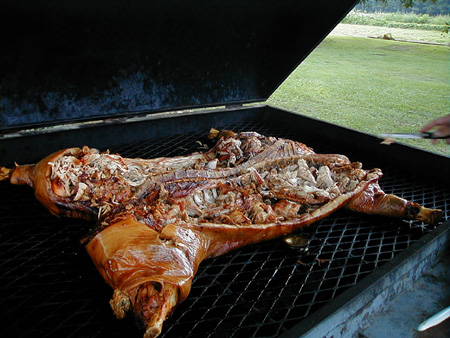
Finally, it’s ready: real pulled pork barbecue.
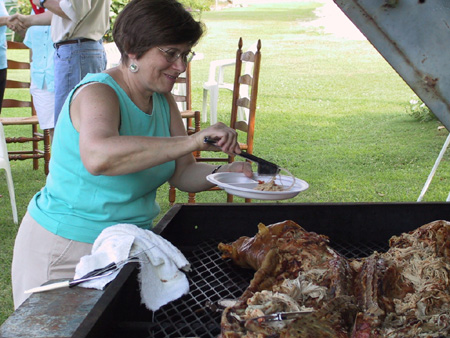
One thing that you might watch out for when you do roast the pig is the rendered fat: so long as the skin is whole, it’ll contain the fat. But once you cut into the skin, that opens a path for the hot fat to travel; if the pig’s over the fire, that could lead to some insanely large flames.

Not that any of that is much help toward your real question, how to roast a pig on a spit, the short answer to which would be, I don’t know. Here’s some advice from some folks who do know, though, complete with some bitchin’ photos to guide your work.

Good luck! I hope it comes out well.

Photo credit: Jim Sharrard