Archive for the 'Advice Column' Category

Food Mill Makes Easy Work of Applesauce

Sunday, November 12th, 2006

Dear Corduroy Orange:

I really enjoy fresh applesauce but I hate the effort of peeling and coring all of those apples. Is there any way I can avoid that?

Peter Rambo

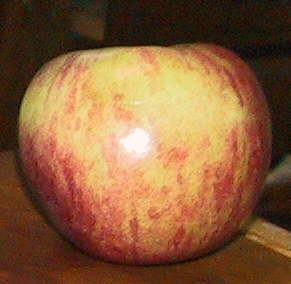
cortland apple grown in Western PA

Dear Mr. Rambo—

There sure is, though unfortunately, you didn’t ask me early enough in the season for you to take advantage of the technique with your namesake apple, which is tart enough to make a tasty sauce.

The secret to making effortless applesauce lies in having a food mill for your kitchen. It’s a handy device that allows you to press the cooked down apples through a sturdy stainless steel sieve. The “saucy” part makes it through the holes; the seeds, skin, and pulp stay behind. The result: smooth and tasty homemade applesauce without having had to peel a thing.

(more…)

Great Pumpkins!

Tuesday, October 24th, 2006

Colonel Orange,

I would like to go to a Pittsburgh area farm to pick pumpkins for carving. Do you have any suggestions?

Can carving pumpkins (uncarved, of course) be used for pumpkin pie? Do you have a recipe for pumpkie pie filling?

Ms. Peacock

Dear Ms. Peacock,

I’m awfully busy carving Mr. Body right now, so I don’t really have much time to research pumpkin patches, and since halloween is fast approaching, I figure I’ll just quickly scrawl what I know:

I don’t know the whereabouts of any patches. Last year, I went to Traxx Farms, I think, which is a huge super-farmstore, but they had a wide selection of squashes and pumpkins. I often get produce from Soergel’s in Wexford, but again, large farmstore, not a patch.

Carving pumpkins can make good pies, but it’s not guaranteed as they’re bred for their size and their looks: so while one might taste just fine, another (even if it looks the same) may be unpleasant to the palate. They’ll still do as well for pies even if they’re carved. My mom used to save the scraps from carving and cook them down; then after halloween was over, she’d cut the carbony black stuff from the candles out of the insiodes of our pumpkins and cook what was left. Impressive, but you don’t necessarily have to go to that trouble if you don’t want to.

Better pie materials include smaller pumpkins, uglier pumpkins (like hubbards), and other winter squashes (like acorn and butternut). Cut into 3/4 inch pieces. Roast with spices and olive oil for 20 minutes or so (or until soft). Puree in food processor or, if you’d like a little more texture, with a potato masher. Because you’ll be truly roasting the squash (as opposed to steaming it in a covered container) and because it’s in such small pieces (thereby increasing the exposed surface area), there shouldn’t really be any excess moisture; however, if it’s not a firm mass when you’re done pureeing, let it drain in a collander (in a bowl; the top covered with plastic wrap and a weight set on top) for several hours or overnight; but, like I said, I don’t think excess moisture should be an issue.

2 cups of puree is equivalent to one can of processed pumpkin for recipe purposes.
The International Academy of Tastes

Thursday, October 12th, 2006

Dear Dr. Orange,

When I was in elementary school we learned about the taste buds on the different parts of the tongue. If I remember right these were sweet, salty, sour and bitter. Recently I heard a story on NPR about another taste called umami that was identified in Japan. I just checked it out and found another possible taste having to do w/ fatty acids. This is really rocking my world! How does a flavor get to be classified as a taste? Is there an International Taste Association? What’s the story? How do food artists like yourself use this palette of flavors to create deliciousness?

Curious in PA

Dear Mrs. PA,

When I was in elementary school, they taught us about the four food groups and recommended getting equal portions each of grain, meat, fruit or vegetable, and dairy: thus the invocation to eat three square meals a day. Things change; you turn around and all of a sudden you’re an old fart eating triangularly and trying to taste six things with a tongue you were told is only good for four, wondering when things stopped being the way they used to (whaddaya mean, Pluto’s not a planet? Did my very educated mother just serve us nothing? apparently.). (more…)

Frankenfurter

Wednesday, October 11th, 2006

Darling Corduroy -

Even though I know hot dogs can’t be good for me, I just can’t say “no” when they’re available at a backyard barbeque or even in my normally healthful fridge. So, I know this is a loaded question, but what are hot dogs made of? Whatever it is, is it safe to eat? Are some dogs better than others? I mean,could they be “graded” like normal meat, or would they all just get an F?

Thanks,
I Put the Hot in Hot Dog

Dear Hottie:

Uh-oh, don’t let my wife know you’re calling me darling; she might get jealous.

Everything in a hot dog is edible; otherwise manufacturers wouldn’t be allowed to put them on the market. In general terms, a hot dog is a sausage made of a 5-4-3 forcemeat: 5 parts meat, 4 parts fat, 3 parts ice or ice water, plus seasonings stuffed into a casing. As with any sausage, it is the recipient of, well, the “less glamorous” parts of the animal: the parts that are more difficult to sell when they’re packaged as themselves: which is to say, the various scraps left over after the animal has been segmented into saleable cuts, etc. If a weiner includes organs (heart or kidney, for example), the organ and the breed of animal it came from must be named in the ingredients list. Different types of hot dogs, though, have different requirements.

(more…)

Vegetable Cookery Crib Sheet

Wednesday, October 4th, 2006

Could you help me out with a cribsheet helping me figure out what order I should satuee vegetables? I was sauteeing a number of different ones for a veggie lasagna recently, and realized that I wasn’t sure what length of time each had to cook relative to the others.

In general, the length of time any particular vegetable is going to have to cook is dependent upon two factors: its size and its density. Assuming you have all of your vegetables cut to pretty much the same size, the following list is a pretty good crib sheet for what order they should be added into the pan:

    1. carrots, potatoes, beets
    2. turnips, parsnips, winter squashes
    3. onions
    4. broccoli stems, fennel
    5. garlic, peppers
    6. broccoli florettes, apples
    7. collard greens, mushrooms, swiss chard stems
    8. zucchini, summer squash, corn
    9. kale, mustard greens, cranberries, tomatoes (if they’ve been juiced and you want them to still retain some of their shape; otherwise add tomatoes as part of any liquid that goes in the dish and use them to help simmer everything else)
    10. spinach, swiss chard, arugula
      Assume a couple minutes of sauteeing (or, if applicable, roasting) time between each level if your vegetables are cut to a small dice; longer the bigger they are. I’m sure I’ve forgotten a few vegetables from the list. If I’ve neglected your favorite veg, post a comment and I’ll fit it into the list for you.

Casing the Joint

Wednesday, September 27th, 2006

Mr. Orange –

What is the “artificial casing” used to contain modern sausage REALLY made of? My personal theory is that it’s plastic, but I’d like to think that the food industry isn’t so obviously damaging my digestive system.

Thanks!

Larry! Larry! Take me to the hospital, Larry! I’m dying! I ate a plastic sausage and if I don’t get to the hospital, I’m gonna die! Just drop me off by the emergency room, Larry! I won’t tell ‘em who you are, I promise!

Wait, no, wrong guy.

Truth is, some casings are made of plastic, but if you eat them, you don’t know how to peel your pepperoni. Plastic casings are those “papers” on certain deli sausages that everyone knows you’re supposed to take off before you eat your meat. Or is that taking it too far?

(more…)

When to Add the Herbs?

Wednesday, September 13th, 2006

yo yo yo jesse,

i finally thought of a question that would probably benefit a lot of us who read your blog. it kind of takes off from your first advice column about sauteeing with pepper. i’ve never really known when the best time to add herbs to something i’m cooking (or if, and how much, this varies depending on the dish). as examples, i commonly use basil, oregano and rosemary, but i’ve never been consistent about when in the process i should add them to the pot. i could probably stand to be similarly schooled on some of the spices out there too. thanks!

justin

Deciding when to add the herbs depends in large part on whether the herbs you’re using are fresh or dried. In general, fresh herbs should be added later in the cooking process so their flavor doesn’t fade away, whereas dried herbs should be added earlier so that their flavor has a chance to develop.
(more…)

Favorite Food Hoax?

Tuesday, September 12th, 2006

Dear Mr. Corduroy,

This is a strange question. I recently read somewhere that depending on the hand you use to eat with, food tastes differently. If you are right handed, and normally eat with your right hand, then by switching and using your left hand to eat with, it will open different taste pathways by using the other hemisphere of your brain. After testing this, I have come to the conclusion that it is a hoax. I was wondering what was the most ridiculous hoax you had heard of concerning food/eating.

Ambidextrous Andy

Dear Andy:

I’ve got to admit, I’ve never heard anything like that before. The concept seems somewhat preposterous, especially since hands are quite often used interchangeably when eating. Think about when you’re cutting a steak: you probably hold the fork in your left hand and the knife in your right hand. Once you’ve cut a chunk off, you may or may not lay the knife down, switch the hand you’re using for the fork, and then eat the piece of steak. Then again, you might not, especially if you’re European, where the general consensus on table manners is that there’s no sense in playing patty-cake with your fork, thus they maintain the fork in their left hand and the knife in their right, just as the utensils are laid out for them before the meal (they’re so pragmatic!).

(more…)

Stop, Drop, and Roll?

Saturday, September 9th, 2006

Dear C. Orange,

Sometimes when I cut onions my eyes hurt so bad that I consider chopping with my eyes closed. Do you have suggestions for preventing this? I’ve heard a few but I forgot what they were!

Thanks,
M. Y. Eyesonfire

I’ve heard of a few suggestions, too—though I don’t know how well any of them work. Peel the onion underwater; chew gum while you’re working with it; freeze the knife before you cut the onion…. Personally, I don’t pay much mind to any of the suggestions and my eyes aren’t usually bothered unless my knife is dull, though if I’m planning on drilling a hole through an onion, I will wear eye protection.
Wear eye protection when drilling holes through onions.

Really, the best way to cut an onion without crying is to improve your technique when slicing onions. The fewer cell walls you break while you’re preparing your onion, the less juice is released; the less juice released, the easier on your eyes. Make sure your knife is sharp. That way, you’ll make a clean incision and have fewer burst cells.

Follow these easy steps to cut your onions while shedding nary a tear: (more…)

Eating Well on the Road

Friday, September 8th, 2006

My job has me living on the road most of the year, and becasue of this I don’t always have the best eating habits. Do you have suggestions on better ways for me to follow the food pyramid while living out of a hotel room?

thanks!

hungry in ohio

HIO–

First things first, let’s forget about the food pyramid. That device was designed by a committee and it shows. Instead of concentrating on meeting the requirements poorly laid out in a jumbled chart, instead think about your diet with some common sense. Realize that your nutritional intake is tantamount to your life—-the only thing you’ve got going for you at any particular time is the sum total of what you’ve eaten lately. Because your diet is of consummate consequence, make the quality of your edibles to be of utmost importance.

(more…)