Archive for the 'How to Use Your Knife Like a Pro (tm)' Category

Maintaining Your Knives

Thursday, November 30th, 2006

Touch a brand-new blade gently with your thumb and it should feel very sharp. As you use it, though, it will naturally grow duller over time. There are two tools that you need to maintain the quality of the blade so that your knife will continue to serve you well: a honing steel and a sharpener. A common myth is that a steel sharpens the blade; actually, it maintains the blade so that it is straight and true. Properly used, it will help keep your blade sharper, longer; used improperly it will dull the blade.
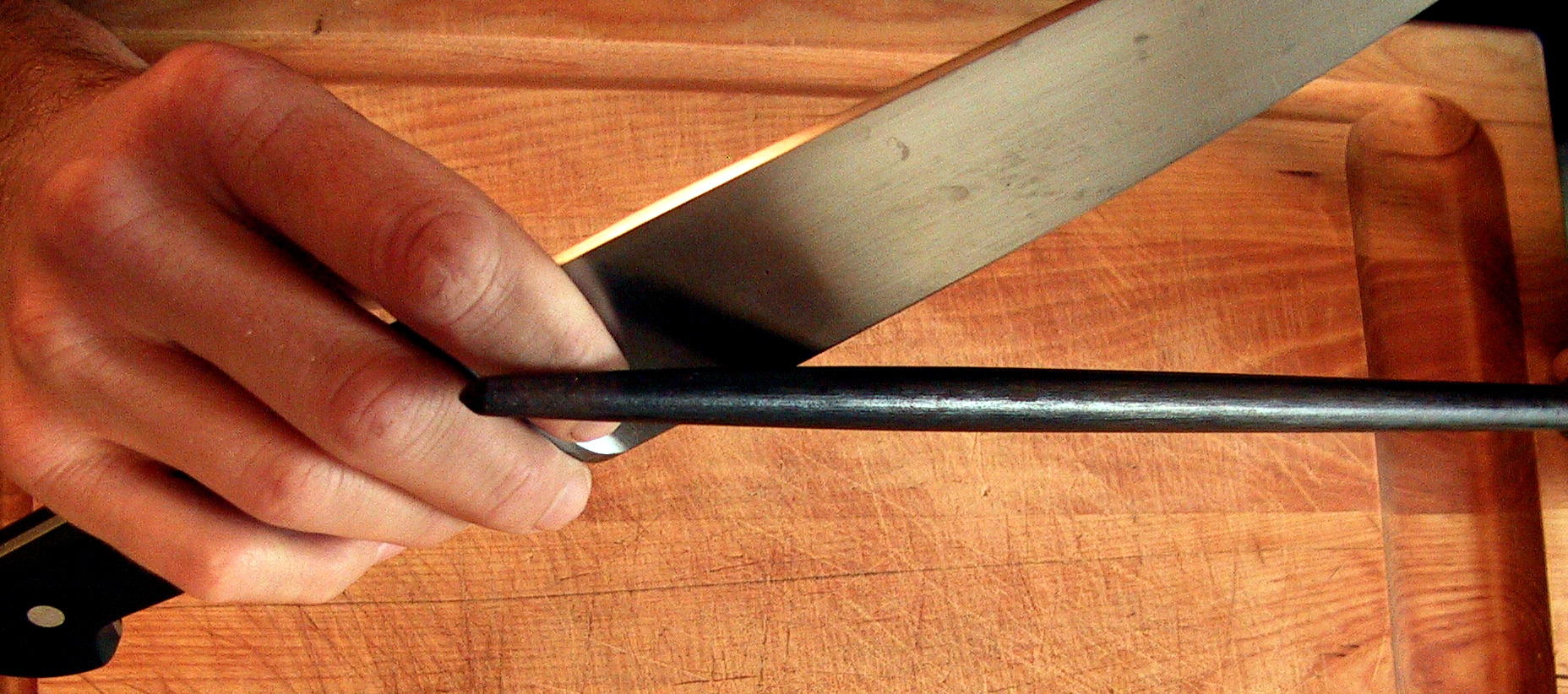
honing your blade, step one

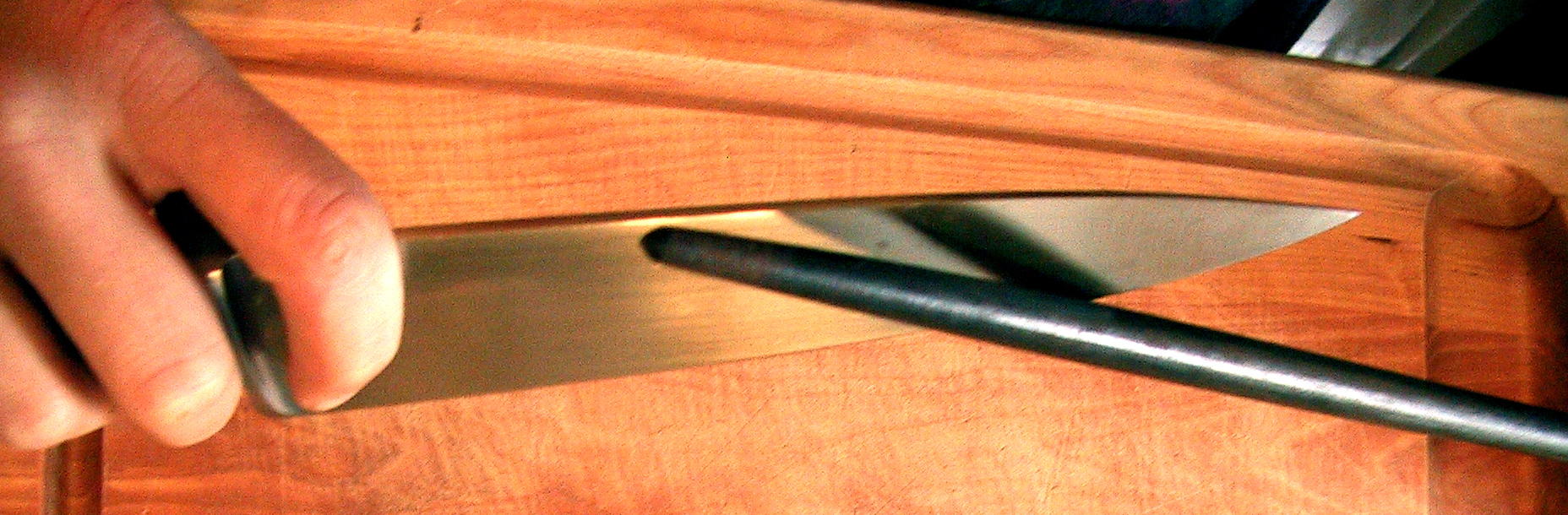
honing your blade, step two

To use the steel correctly, grasp it in your guide hand and hold your knife in your dominant hand. Next, find the appropriate angle between your blade and the steel, about 20 degrees. The snooty-snoo guy at the knife counter in the upscale kitchen store will advise you that the exact angle desired is 22.5 degrees; but, in all reality, as long as you’re in the right ballpark, you’ll be doing your knife more good than harm. His guideline can be helpful, though, especially since his angle might be even easier to find than the ballpark figure: hold it at a 45 degree angle, and then cut the angle in half. You’ll be right where you want to be. Starting with the heel of the blade (the end closer to the handle), turn your wrist so that you scrape the blade evenly across the steel in one fluid motion. Repeat for the other side of the blade. Get each side of the blade 4-6 times, but not more than that: over-honing your blade will dull it prematurely. Most new steels have a shield at the top of the handle to protect you from accidentally slashing your thumb while honing the blade. Make sure you keep your thumb behind this shield, because if you’re not paying attention, it’s easy to give yourself a healthy laceration. If your steel happens to be an older model without a shield, make sure you watch where your hand is and make certain that it’s well out of harm’s way.
(more…)

Buying Knives

Tuesday, November 28th, 2006

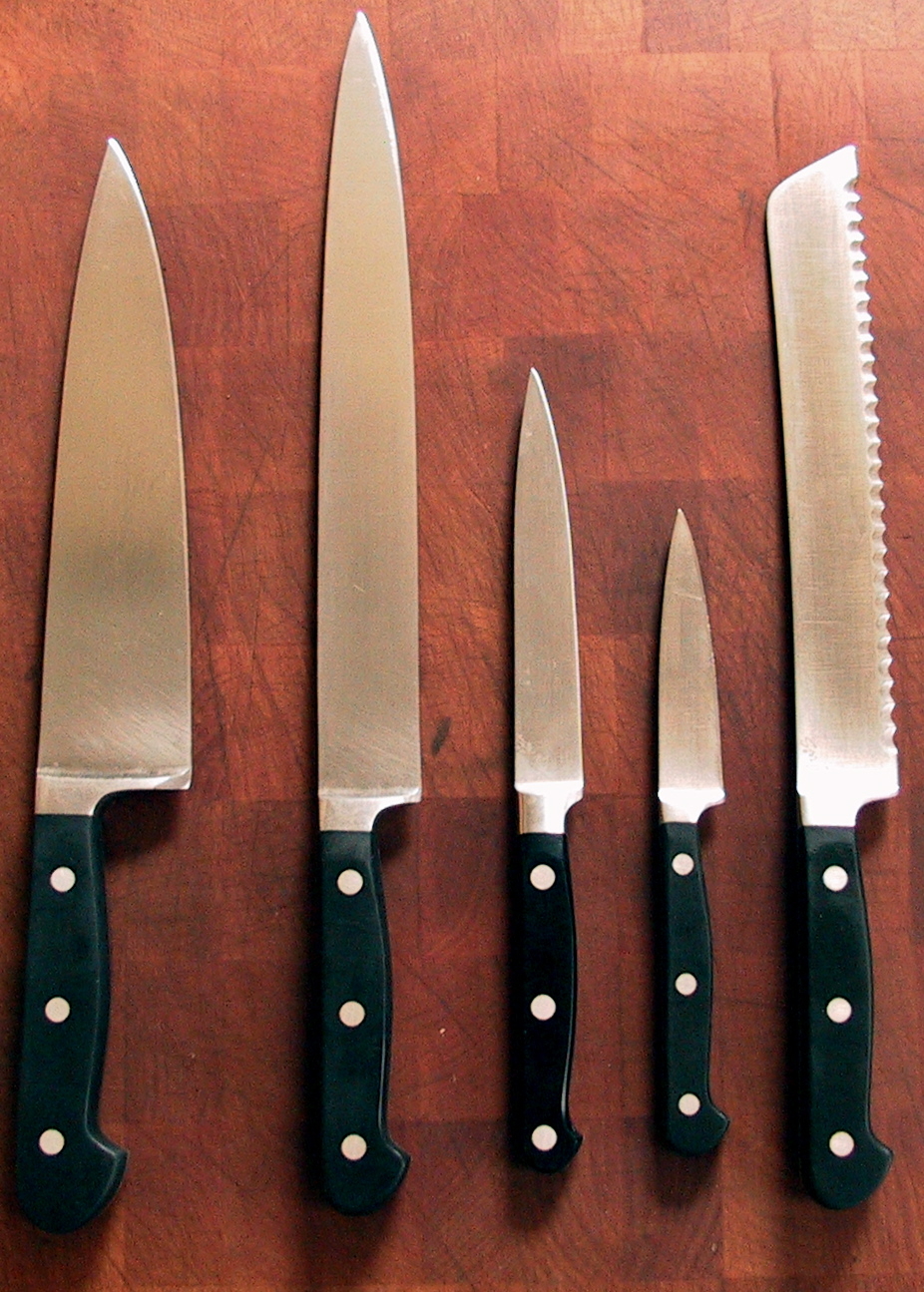
all the knives you really need
Everybody has ‘em, everybody uses ‘em, but most people don’t know how to choose ‘em or how to maintain ‘em so they’re constantly sharp, which is a shame, because there’s no kitchen tool more dangerous than a dull knife. A dull knife is far more apt to slip off of what you’re trying to cut, which means that it’s more apt to catch you instead. Once it catches you, it’s less likely to make a clean incision, and you wind up with a jagged, painful, slow-to-heal wound. Nobody wants that, so put down whatever else you’re doing and pay attention—here’s the skinny on how to choose a good set of knives for your kitchen and how to keep them in tip-top shape.

(more…)

Cut the Hassle out of Cutting Peppers

Friday, November 3rd, 2006

Use your knife wisely to cull the pepper from the seeds

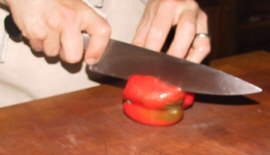
I’ve seen lots of people cut peppers lots of ways, some more effective than others. This method is my favorite; if your knife is sharp and your aim is true, your pepper simply unrolls from the seed core under the gentle influence of your blade.

begin

Begin by slicing down through the pepper outside of the dimple around the stem. As you cut, look at the structure of the pepper: the “meat” of the pepper is held to the seeds by only a few arches of soft, white pith. What you want to do is to sever these arches without disturbing the seeds.

As you reach the bottom of the pepper, turn your knife as you simultaneously roll the pepper. Carefully slice through the pith arches while keeping your knife parallel to the cutting board.

Ideally, the pepper should come apart in one continuous strip with very few seeds accompanying it.

Next, you should remove any tag-along pith from the pepper. The pith is bitter or, in the case of hot peppers, spicy, and is generally considered undesireable for most purposes.

Again with your knife parallel to the cutting board, and again extremely carefully, slide your knife blade between the pith and the pepper. This step is actually a bit easier than it may look because the pith is of a much softer texture than the pepper and therefore slices away from the harder vegetable without much resistance. The main thing you want to be careful of during this step is not to accidentally nick your fingertips with the blade—move them out of the way as it approaches!

Cut the end of the pepper from the seed core for maximum product utilization (in other words, so as not to be wasteful)

Then, slice and dice your pepper according to standard procedure.

Photo credits: Aurora Sharrard

The Most Efficient Way to Core an Apple

Friday, October 13th, 2006

Hint: It’s not with an apple corer

It’s very easy to get the largest possible yield from your apples. This 30-second video shows you how.

see how it's done!

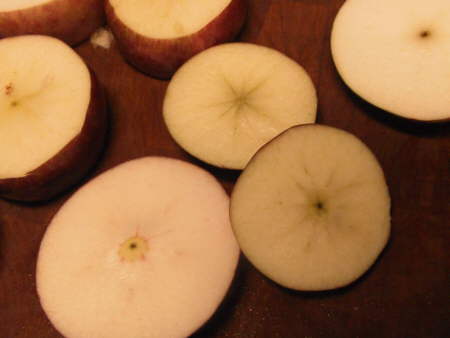
Slice the apple in thirds parallel to the equator of the fruit. Then, cut around the small, green circle of the core. There is less core at the top and the bottom of the fruit than there is in the center where the seeds are. By dividing the apples into thirds, you get a higher percentage yield than if you use a corer or slice across the whole fruit.

Why It’s Better to have Good Knife Skills than a Good Food Processor

Tuesday, October 10th, 2006

One argument I’ve occasionally heard against going through the somewhat difficult process of learning to use your knife like a pro is, “I don’t really need to be able to do all of that because I’ve got a good food processor.” If that’s the case, I’m glad for you; a food processor can be a very valuable tool to have.

Give me a choice between a sharp knife and a food processor, though, and I’ll choose the knife almost every time. Not that the food processor doesn’t have its place occasionally: I’d never be able to make bread crumbs from leftover heels of stale, frozen bread without mine. Likewise it’s handy if I want to grate a large amount of cheese or perhaps even to make pesto (though quite honestly, I think the blender a better tool for that task). As far as mincing vegetables goes, though, I’d just as soon cut mine to a very fine brunoise; and unless I’m making a very huge coleslaw, I’ll shred my cabbage manually, too.

(more…)

Huevos con Papas y Col Rizada

Monday, October 2nd, 2006

Eggs with Potatoes & KaleI don’t really have any reason to believe that this dish is of Hispanic origin; I just like the way the Spanish name sounds when you say it out loud. Especially if you know how to speak the language with a decent accent, something I’m unable to do. It’s extremely simple to make and quite tasty; an excellent breakfast or dinner. I suppose you could have it for lunch, too, if you really wanted, but most of the time it seems like lunches aren’t cooked on the stove. Probably because most of the time they’re eaten out of paper bags and contain phrases like “salad” and “sandwich” because we tend to eat them on the go; but that’s neither here nor there.

eggs with potatoes and kale

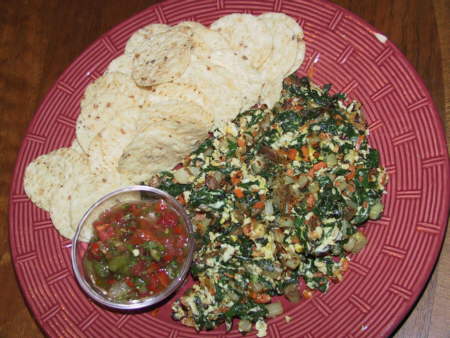
Eggs with potatoes and kale, pictured here with tortilla chips
and roasted tomatillo salsa

I remember the first time I heard of kale. I was watching re-runs of Cheers one evening while I was still in high school. Woody was spokesperson for a health drink he’d never tasted. When he finally did, he spat it out and screamed, “What’s in this stuff?”, looked at the ingredients and spluttered, “Kale! I don’t even know what kale is!”

It wasn’t for another eight or ten years that I actually tasted the stuff. It turns out that kale is a nutritious and tasty leafy green. It might not be something you’re accustomed to having in your produce drawer, but you should become familiar with it because it’s so good! Most of the time it’s braised or steamed; but I like this preparation because it incorporates the heartiness of the kale into the meal as a whole.

(more…)

The Best Way to Peel Garlic

Tuesday, September 19th, 2006

Too many people spend way too long extending and protracting the process of peeling a clove of garlic. There’s no need to roll it in a rubber sheath nor strip at it with a paring knife. Life’s too short to waste time on such unnecessary inefficiency. Three steps, five to ten seconds, your garlic is peeled.

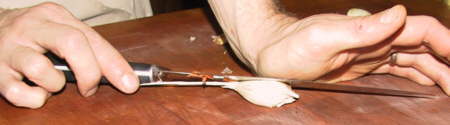
1) Place your knife flat upon the garlic.

place your knife upon the clove

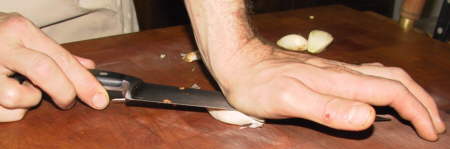
2) Press down firmly, but do not strike the blade.

press down but do not strike

3) Grasp the peel at the sprot end in one hand and the garlic at the root end with the other.

take one in one hand and the other in the other

They come apart effortlessly. If you have to peel a lot of garlic, perform each step on all cloves before proceeding to the next step. Only press down on one clove (or clove group, if a couple or three cloves are stuck together as one) at a time. If you’re trying to mash multiple groupings, none of them come apart as well or as quickly as if you were to do each separately in succession.

Also, if you need a great deal of garlic for any particular purpose (~1 bulb or more), place the bulb on your cutting board root side up and press down on it as you would to peel a single clove of garlic.  The cloves will come apart from the bulb much more quickly than if you were to try to pull them all off individually.

Making Perfect Knife Cuts

Monday, September 18th, 2006

For most vegetables (carrots and onions being two of the few exceptions), the most efficient way to dice them also yields perfect results. If you are able to keep the pieces of your veggies organized into neat stacks, you will be able to slice through them several layers at a time, swiftly producing beautiful cuts.

batonnet batonnet: 1/4″ x 1/4″ x 2-2.5″

julienne julienne: 1/8″ x 1/8″ x 2-2.5″

fine julienne fine julienne: 1/16″ x 1/16″ x 2-2.5″

small dice small dice: 1/4″ cubed

brunoise brunoise: 1/8″ cubed

fine brunoise fine brunoise: 1/16″ cubed

(more…)

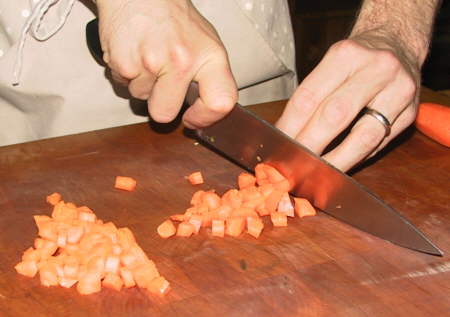
Dice Carrots with Celerity!

Thursday, September 14th, 2006

Three steps to make quick work of your roots

Most knife skills books will have you square your carrot off, slice exact planks, segment the planks into sticks, and finally cut them down to a precisely diced finish. It’s a painstaking, time-consuming process even with the sharpest of knives. The results that method yields are undeniable, and if you’ve got lots of time and exactitude of your finished vegetables is important to your presentation, it makes sense to follow the long way.

These results in less time than you think possible!

For most purposes, though, it just doesn’t make sense to labor over perfecting each orange box into exact 1/4-inch cubehood. So, why bother? Get 96% of the results while spending just 23% of the time by following these three easy steps. Your salads will look better, your stews will cook more uniformly, and you’ll get out of the kitchen sooner—it’s a win-win-win situation.

(more…)

Stop, Drop, and Roll?

Saturday, September 9th, 2006

Dear C. Orange,

Sometimes when I cut onions my eyes hurt so bad that I consider chopping with my eyes closed. Do you have suggestions for preventing this? I’ve heard a few but I forgot what they were!

Thanks,
M. Y. Eyesonfire

I’ve heard of a few suggestions, too—though I don’t know how well any of them work. Peel the onion underwater; chew gum while you’re working with it; freeze the knife before you cut the onion…. Personally, I don’t pay much mind to any of the suggestions and my eyes aren’t usually bothered unless my knife is dull, though if I’m planning on drilling a hole through an onion, I will wear eye protection.
Wear eye protection when drilling holes through onions.

Really, the best way to cut an onion without crying is to improve your technique when slicing onions. The fewer cell walls you break while you’re preparing your onion, the less juice is released; the less juice released, the easier on your eyes. Make sure your knife is sharp. That way, you’ll make a clean incision and have fewer burst cells.

Follow these easy steps to cut your onions while shedding nary a tear: (more…)