Archive for May, 2007

Notes From A Lecture by Michael Pollan

Thursday, May 10th, 2007

I saw Michael Pollan when he came to Pittsburgh on March 5 as part of the Drue Heinz Lecture series. Its one of two big lecture series in Pittsburgh and just a small part of the bonanza of cultural offerings this city has to offer.

It’s interesting that even as our communication methods change, the lecture still draws a crowd. True, the Drue Heinz Series draws speakers who are top in their field, and usually focuses on topics that are of interest to the public at large, even when most ideas are exchanged nowadays via digital transmission. Even in a hall of hundreds who had come specifically to hear this speech, a flurry of activity fluttered through the crowd when the emcee began his introduction by saying, “I’m sure all of you have by now already turned off your cell phones and pagers.” It’s a rare opportunity anymore to sit and focus your attention on an individual in the flesh, sans electronic distractions. Indeed, it’s a lot to expect of a person to entertain a crowd whose attention spans have been whittled away by modernity.

Mr. Pollan did not disappoint. He held the crowd enraptured for the length of his speech and through the allotted question and answer period. If he had remained on the stage, the audience would probably have continued to lob follow-ups to follow-ups at him well into the night.

He started the lecture by pointing out the silliness of our nation’s eating habits: as a whole, we are susceptible to diet crazes and shift our eating habits according to the most recent expert opinion. It is symptomatic, says Pollan, of a “national eating disorder.” He went on to say that the success of his most recent book, The Omnivore’s Dilemma, is yet another symptom of the same problem: there would not have been need for 450 pages on this topic at any other time or in any other culture; yet, here and now, the message is one he feels compelled to deliver.

(more…)

Nope.

Monday, May 7th, 2007

So I noticed that you occasionally mention products in your posts–most recently the kitchen-aid immersion blender. I’ve also been reading about word-of-mouth marketing campaigns where bloggers and people are paid to talk up products as if they’re the coolest shit in the world. Are you getting paid for this?

Wait—bloggers and people getting paid? Bloggers aren’t people? It’s not like when I started writing this I gave up my humanity.

But, no, I’m not getting paid for any of this. No money exchanges hands for Corduroy Orange, unless you count the money I pay to my web hosting company. I mention products because I like them and I think they’re useful.

My brother’s been suggesting that I sell some ad space on the page, but I’m not sold on that idea. I can’t even stand at a urinal anymore without having an ad in my face, and I like the idea of having ad-free space.

I suppose if in some lapse of judgement a company offered me money to promote their product and it were a product that I used and liked, I would agree to the arrangement (and disclose it); but I don’t see that happening anytime soon, especially because I’m more apt to encourage people to buy less and reuse what they already have instead of running out to grab more junk that they don’t really need. Not to mention that I hardly have the name recognition advertisers seek when they dole out sponsorship dollars.

Still, though, I see some people hawking their things on TV and I have no idea who they are: like that guy who’s been promoting his new menu items at Applebee’s—I’d never seen him before his mug showed up on that ad. And that’s hardly a great first impression: the guy who schleps his stuff for a national chain with so few distinguishing characteristics that it could be any one of several similarly blah establishments. I suppose he’s getting paid pretty well for it, but I’ve got a tough time taking anyone seriously as a “celebrity chef” who obviously has no integrity about the source of their ingredients or the quality of their product.

So, to make a short story long, I don’t really have interest in pursuing advertising dollars. I’d much rather be well connected to the sources of food near me; to know the farmers and where my food comes from; and to encourage others to do the same. I’d much rather see the national conglomomarket fade and be replaced with many overlapping local networks of people connected to the land around them, the natural flux of seasons, and the way food ought to be grown and raised.

A Couple of Thoughts About Barbecue

Thursday, May 3rd, 2007

So while I’m on the topic of pulled pork barbecue, I thought I’d address the topic of what’s what.

Personally, I like Eastern Carolina style. It’s dressed with a spicy, vinegar-based sauce. It’s thin, liquidy, and dresses the meat in a visually subtle manner, though it packs a lot of flavor.

Go westward through Carolina and you’ll find a tomato-based sauce. I’ve only had this a couple of times, but to me it seems much more like the kind of barbecue sauce you’d get from the store: thick and red, with a standard, unsurprising flavor.

Don’t even get me started on South Carolina: they put mustard in their barbecue. It’s a travesty and it ought to be a crime (along the lines of putting tomatoes in clam chowder, which is rightfully outlawed in Massachusetts).

Kansas City barbecue is a strange phenomenon. You get the meat, and then the restaurant has a wall full of sauces and you can choose what you will to dress your own sandwich. I suppose a bit of variety can be a nice thing to have, but when I go to a restaurant, I like when they prepare my food for me, and that includes tossing the shredded meat with the sauce to evenly coat it. They’ve got the advantage of having large bowls in which they can toss the meat, whereas when they give it to you to dress yoursel, your stuck having to pour it over the top–whereby half the meat gets loads of sauce and the other half is still nude. I’d much rather they serve me a fully-prepared meal.

I’ve only been to Texas once. Houston. I hated it. Too many highways, too much sprawl, too many Texans. I may have been remiss in not having barbecue while I was there, but I was also stuck without automotive transportation in a non-walkable city, so my options were few. Nonetheless, I’m unable to offer an opinion on Texas barbecue except to say that I can’t imagine any barbecue good enough to lure me back to that hellhole of a state.

So You Want To Roast A Pig?

Wednesday, May 2nd, 2007

I had this crazy idea to have a pig roast in the next month or so, after watching the Indonesia episode of No Reservations. I want to get a whole pig, fill it with herbs, and throw it on a spit in my yard. The first question is, how should I go about procuring a pig? I found this one place:
http://www.wildenfamilyfarms.com/Main/product.html

It looks like it will run about $230 for a 170lb pig. Any ideas for other places or is that a good price from a reputable place? The next piece of the problem is getting the thing gutted. The place above charges $110 for that. How hard is something like that to do myself?

Do you have any other suggestions for things I might be missing?

Thanks,
serge

Serge—

First off, wherever you decide to get the pig, pay them to gut it. It’ll be so much easier, and you won’t have to worry about entrails and noxious odors.

I’m familiar with Wilden Farms, and you’ll get a good product from them. A couple of other Pennsylvania farms offering responsibly raised pork are Mickley Organic Farms, 724.530.2207 and Heilman Family Farm, 724.353.1411. I’m not sure what sort of price they would offer for a whole animal, but it’s probably worth checking.

I’ve never actually roasted a whole pig on a spit. At one of the restaurants where I worked, there was a party that requested three whole pigs that the chef didn’t get in the oven soon enough and then had to turn the heat up on to get them cooked in time. The result was good, but not as good as it would have been if he’d done them properly, for a longer time at a lower heat. But that was in the oven, and I doubt if your oven would fit the whole animal (I know mine probably wouldn’t).

There’s a danger to cooking the pig for too long, though. When my dad was in the Navy, one of his superior officers held a pig roast for his whole unit. The guy in charge of cooking the pig claimed he knew what he was doing, dug a hole in the ground, built a fire, added the pig wrapped in a wet burlap sack (he wanted banana leaves, but they weren’t available), covered it up, and said that it would be perfect the next day. The next day came and everyone showed up at the party (where the side of the garage was obscured by cases of Pabst Blue Ribbon stacked it’s entire length and height). They dug the hole open to find nothing but ashes.

I’m not sure where they were getting their pigs from (I was a long time away from existing at this point), but somehow they ran out and procured another one (maybe the base got pigs in whole?) and started the process again. Trouble was, the house wasn’t on the base, it was in civilian-land, where the neighbors aren’t big fans of a yard full of Pabst-drunk sailors making a ruckus. The cops showed up and told them they had two choices: go inside (the small bungalow-type cottage) or disperse. Everyone knew the second they started their vehicle they;d be in for a DUI, so they all crammed into the cottage. The pig was nowhere near done and everyone was getting hungry, so they ate rare pig. No one got arrested and no one got sick, so there could’ve been worse outcomes to the day.

As far as successful pig roasts go, my mom’s family has occasional pig pickin’s that sound like lots of fun, but unfortunately I was never in North Carolina at the same time one was being held. They roast a whole pig, but not on a spit: on a grill made from a converted oil tank.

They flay the pig out and roast it slowly–starting it in the morning so it’ll be done by dinner.

When it gets to be almost done, they dress it with a vinegar-based sauce.
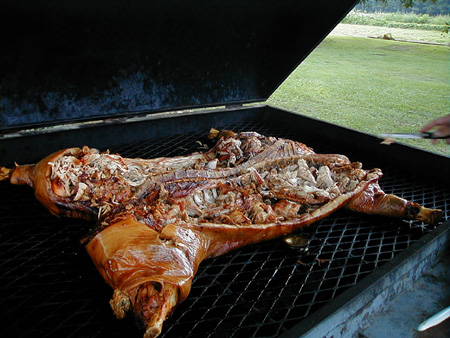
Finally, it’s ready: real pulled pork barbecue.
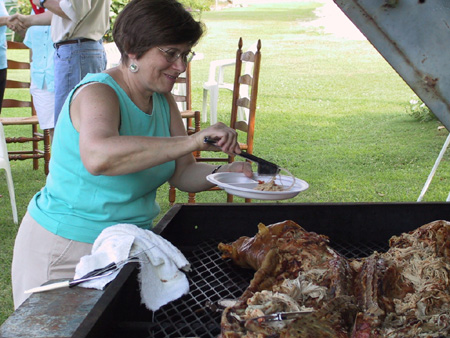
One thing that you might watch out for when you do roast the pig is the rendered fat: so long as the skin is whole, it’ll contain the fat. But once you cut into the skin, that opens a path for the hot fat to travel; if the pig’s over the fire, that could lead to some insanely large flames.

Not that any of that is much help toward your real question, how to roast a pig on a spit, the short answer to which would be, I don’t know. Here’s some advice from some folks who do know, though, complete with some bitchin’ photos to guide your work.

Good luck! I hope it comes out well.

Photo credit: Jim Sharrard