Archive for the 'Tastings' Category

A Little Treat from Amsterdam

Thursday, December 7th, 2006
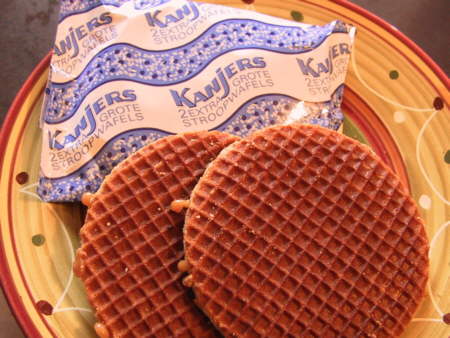
Kanjers Stroopwafels

My friend Shaz emailed me the other day to tell me, “I have a treat for you from Amsterdam—and no it’s not what you’re thinking.” U.S. Customs laws being what they are, I knew it wasn’t what she thought I thought, but I had no idea to expect Kanjers Extra Grote Stroopwafels, mainly because I had no clue that they existed.

The Extra Grote Stroopwafels (translated by Babelfish as “Extra Large Stroopwafels,” with no indication of what sort of modification on waffle “stroop” indicates, even when entered by itself) are a tasty confection consisting of caramel sandwiched between wafer-thin waffles. Exceedingly sweet, these aren’t exactly breakfast waffles. Really, they’re more like a cookie and they match very well with a mug of hot (unsweetened) coffee. I was rewarded when I set my partially-eaten stroopwafel atop my mug for a few moments to take a break from it (like I said, they’re incredibly sweet). When I returned to it, the stroopwafel was warm and the caramel filling had melted a bit; it was a pleasant variation on the theme.

My friend Tom tells me he saw Stroopwafels for sale at Craig Street Coffee here in Pittsburgh (305 S. Craig Street), and a quick phone call to Mon Aimee Chocolate, which specializes in imported confections, confirms that they’re usually available there, too (2101 Penn Avenue in the Strip District). These cookies are definitely something worth checking out when you’ve got a sweet tooth screaming to be satisfied.

It’s nice (though, in a way, it can also be disheartening) to realize that the food products widely available in the U.S. don’t represent the entirety of what’s popular on the world market. Many new tastes are out there (albeit in a niche, foreign-import market) that can help you break out of the mass-market box, if you know where to look for them. One of the more satisfying ways to find out about these things is to travel outside of the country. Unfortunately, it’s also one of the more difficult methods, as well. If you’re on a more limited budget and/or timeline, search out the specialty shops in your city. You might not find what you’re looking for, but you’re bound to find something that you didn’t know to look for, which means you’ll still be expanding your horizons, even if you don’t need a passport.

Baking Bread with Enrico Biscotti’s Larry Lagattuta

Monday, November 6th, 2006

Learning everything Scott Baio knows about bread making.

Larry Lattuta explains some of the finer points of bread baking

I think we all realize that extruded loaves of supermarket bread aren’t very good, but a day of baking bread with Larry Lagattuta teaches you (among other things) what utter crap they actually are. “Our bodies can’t digest unincorporated flour,” explains Larry while describing why you want to be frugal with the flour you put down on the table while you shape your loaves, “but the only way they can get the dough soft enough to plop into the pans in the bread factory is by adding lots of water. Water makes it sticky, so they coat the insides of their tubes with flour so the dough will go through. The result of that is, lots of undigestable flour winds up in that bread,” the end result being that our bodies rebel against the onslaught and develop allergies to wheat. (more…)

Thoughts on Mars

Monday, October 30th, 2006

Some musings on the candy I’m gonna be giving the little buggers tomorrow.
Very rarely do I buy milk chocolate candy bars. More often if I get chocolate, it’s 70+% cocoa solids and comes in a snooty-looking wrapper. Come Halloween, though, when the kids in costume bypass my house because there are too many stairs to walk up to get to my front door, I usually have a couple of products from the Mars corporation on hand in case any of them actually do decide to make the vertical hike.

I think it’s interesting how Mars candy bars are variations on a theme: nougat and milk chocolate, which, interestingly enough, is sold as a Three Musketeers, not a Mars bar. Depending on how many additions you want, there’s most likely a variation that suits your taste.
Exactly what a Mars bar is, though, is up for debate because it doesn’t have a consistent identity throughout the global marketplace. Anywhere I’ve ever gotten a Mars bar from outside of the U.S. (Canada, U.K., Asia, Europe), it’s been milk chocolate and nougat plus caramel; the equivalent of what in the U.S. market is sold as a Milky Way.

The most popular variation off of the Milky Way/Mars is the Snickers, which takes the chocolate, nougat, and caramel, then adds peanuts. The result? More body and texture, plus a semblance of not being entirely junk calories.
In the States, a Mars does exist, though it’s not all that popular. It’s sort of like a Snickers-sub almonds, and really is pretty good. For some reason, though, even though everybody in the States knows that Mars makes Snickers, very few of us eat the bar that bears the company’s name in the U.S. I’m not even sure why the company does it that way, with an identical bar being named differently in various regions of the world. The only reference to the dichotomy of names on their website acknowledges the disparity but does not explain it,

It all started with Frank Mars back in 1911 when he and his wife Ethel started making and selling a variety of butter-cream candies from the spotless kitchen of their home in Tacoma, Washington. In 1920, after visiting a local drugstore with his son Forrest, he thought what a good idea it would be if they could produce a version of chocolate, malted milk that could be enjoyed anywhere. The result was the MILKY WAY bar - known in Europe as the MARS bar.”

Another thing I’m not sure of is if there’s a global equivalent of the U.S.-style Mars; a bar in Europe that’s a Mars-plus-Almonds. Anybody know? Please post a comment.

The International Academy of Tastes

Thursday, October 12th, 2006

Dear Dr. Orange,

When I was in elementary school we learned about the taste buds on the different parts of the tongue. If I remember right these were sweet, salty, sour and bitter. Recently I heard a story on NPR about another taste called umami that was identified in Japan. I just checked it out and found another possible taste having to do w/ fatty acids. This is really rocking my world! How does a flavor get to be classified as a taste? Is there an International Taste Association? What’s the story? How do food artists like yourself use this palette of flavors to create deliciousness?

Curious in PA

Dear Mrs. PA,

When I was in elementary school, they taught us about the four food groups and recommended getting equal portions each of grain, meat, fruit or vegetable, and dairy: thus the invocation to eat three square meals a day. Things change; you turn around and all of a sudden you’re an old fart eating triangularly and trying to taste six things with a tongue you were told is only good for four, wondering when things stopped being the way they used to (whaddaya mean, Pluto’s not a planet? Did my very educated mother just serve us nothing? apparently.). (more…)

In (further) Praise of Tomatoes

Monday, September 25th, 2006

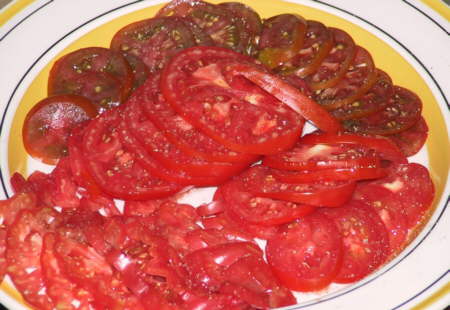
Everybody should love a good tomato fresh-picked from a backyard garden, sweetly tangy and full of juice. Eaten from the hand like an apple, its skin resists just briefly before it bursts and yields its flavor to your tongue. Sliced and sprinkled with a touch of sea salt and some cracked black pepper, they are one of the simplest delicacies known to cuisine, a gourmet accomplishment within the abilities of any cook.

sliced tomato goodness

In the foreground is a sliced pink accordian tomato, which grows with a ruffled, dimpled surface. In the background is a purple cherokee, which ripens to a rich, plum color. In the middle are two varieties which, sadly, I cannot identify because my version of gardening tends to have a greater resemblance to gathering, but both came from feral plants in my backyard.

(more…)

The Difference Between Farm Eggs and Factory Eggs

Monday, September 4th, 2006

It really does matter, and proof is as easy as a picture.

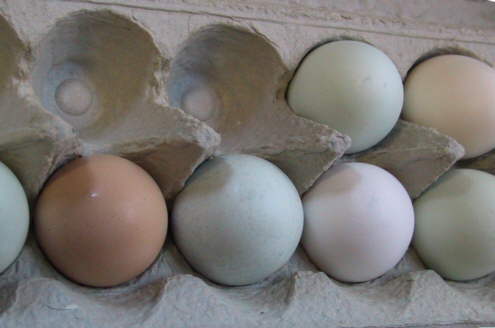
Eggs come in several colors–not just brown and white, but pink and even green. That’s because different breeds of chicken lay different colors of egg.

A range of shell colors

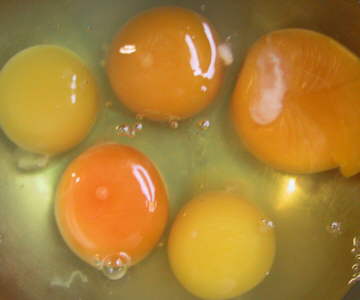
Crack them open and notice the yolk color: Farm eggs have a much more vibrant yolk than do supermarket eggs. Seeing the two of them next to each other really drives the difference home.

compare the colors of the yolks

The difference isn’t just visual, either–it’s a taste difference, too. The fresher, farm raised eggs are richer and eggier. Not to mention the health difference: the farm eggs are free of hormones and antibiotics. One supplier of farm fresh eggs to the Pittsburgh area is Silver Wheel Farm. Read more about them in the article I wrote for the East End Co-op newsletter.

Whaddya mean, there’s more than one type of garlic?

Tuesday, August 22nd, 2006

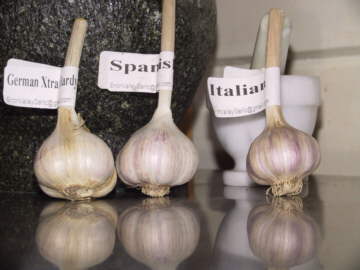
three types of garlic

Yes, it’s true! Though you might only see one variety of garlic at the supermarket, there are indeed many more than that–perhaps as many as 600 different cultivars. A good description of the many types of garlic and the families that they fall into is available at http://www.gourmetgarlicgardens.com/overview.htm, but a quick (and overly simplified) break down of it is that garlic can be hardnecked or softnecked, which refers to the stalk that grows above the ground from the bulb, and can come in a variety of colors. The garlic that you usually find at the grocery store comes from the artichoke garlic subgroup. According to gourmetgarlicgardens, “Artichoke garlics are the commercial growers’ favorite because they are easier to grow and produce larger bulbs than most other garlics.”

The garlics I tasted fall into two other types: Rocambole and Porcelain. The Spanish and the Italian garlics are both Rocambole. The German Extra Hardy is a Porcelain. All three had more flavor and character to them than the supermarket-garlic I compared them to.

(more…)