Archive for the 'Sustainable Food' Category

Sharing 1/4 of a Bovine

Wednesday, January 17th, 2007

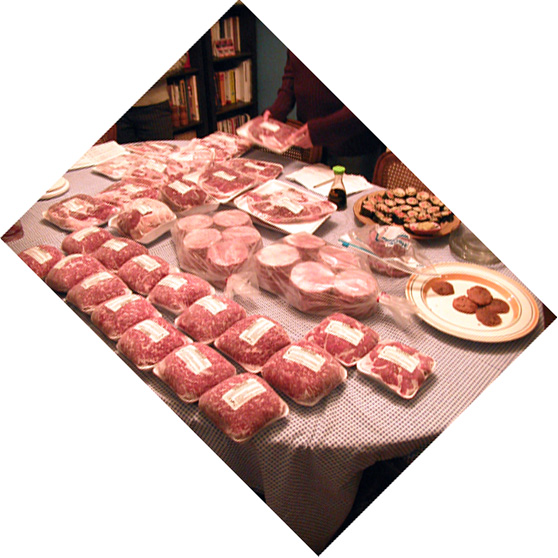
1/4 cow, butchered and ready to share

One of the benefits of being a chef is that when friends find out about something related to food, I’m often among the first to be told. So it went with my friend Andi, who is a veterinarian, when she found out that some people she knows had slaughtered and aged one of their pasture-raised beef steers and were looking to sell it wholesale. For a couple of days, it looked like we would have a 1/2 share of the cow to distribute among interested parties; then, at the last minute, our share had dropped to 25%. Still, though, that translated to 80 pounds of meat: enough for six families to get as much as they were interested in having of various cuts of beef.

When the meat entered our house two days before the “draft,” I was at first surprised by how little meat 80 pounds actually translated into. I hadn’t expected we would be able to house the entirety of it in our freezer. Turns out, it fit comfortably on two shelves of it. It wasn’t until the draft got underway that I realized how much meat we actually had on our hands.

(more…)

WHY????

Monday, January 8th, 2007

Is anyone else as freaked out by the FDA’s preliminary approval of clones in the food chain as I am?

This is one of those situations where I’m convinced that industry lobbyists have more power than is good for us. Yes, I know that the FDA’s preliminary approval comes after five years of study, and I also know that their exhaustive study has found that milk and dairy from cloned bovine, goats, and swine (but notably not sheep) is indistinguishable from that of naturally-bred animals. I also understand, as the FDA’s press release describes it, that “Because of their cost and rarity, clones will be used as are any other elite breeding stock — to pass on naturally-occurring, desirable traits such as disease resistance and higher quality meat to production herds. Because clones will be used primarily for breeding, almost all of the food that comes from the cloning process is expected to be from sexually-reproduced offspring and descendents of clones, and not the clones themselves.”

What I don’t understand is, if the clones are indistinguishable, why bother using them in the first place? I mean, why not just let a bull hump a cow like nature intended? (I know, mass-market meat is already beyond that process; instead they inject sperm from a bull into a cow when thermometer readings have shown that the cow is most fertile and therefore most ready to make use of the commodity…)

Key word from the FDA’s quote describing where cloned animals will wind up: almost all of the food…. But basically, yeah, once that breeder’s put in her time and she’s not spittin’ ‘em out as reliably as she was a year ago, it’s straight to the processing plant with her so she can be made into hamburger meat. But that’s also assuming that as a food-purchasing public, we’re going to be comfortable with the breeders and the bulls being the same breeders and bulls, generation after generation because somebody decided that this matched pair makes beautiful angus steaks together. Am I being unreasonable here when the only response I can come up with to this situation is, Because it’s just not natural, that’s why!?

I suspect that I am, which is why I’m going to wait a couple of days and try to come up with a more eloquent objection to make before I submit my comment to the FDA. However, I encourage everyone to take advantage of the limited window that the bureaucracy gives us to voice our opinions and submit a comment before April 10, 2007.

Really, though, it’s remarkable that the FDA is only allowing a three-month window for public comments to be submitted. They’ve got five pages worth of topics on which they’re currently accepting comments, many of which have comment periods of a year or more. If they spent five years doing the preliminary research on this subject, why not wait another year and have a longer period of public commentary about what is almost certain to be the most contentious issue on their docket? I just don’t understand….
Return to the Mother Sauce

Thursday, December 21st, 2006

Hollandaise—it’s not just for asparagus and eggs benedict anymore

In its essence, hollandaise is a very simple sauce, consisting of little more than egg yolks and melted butter seasoned with salt, cayenne pepper, and lemon juice. Because it is so simple, the results of your sauce rely in large part upon technique. Made incorrectly, the hollandaise will break and greasy butter will float upon slightly scrambled eggs. Fortunately, there is a never-fail technique that takes advantage of modern technology to get perfect results every time.

(more…)

Striving Toward Sustainable Agriculture

Friday, December 15th, 2006

A recent article in The Economist has questioned the wisdom of efforts aimed at making agriculture more sustainable. A key passage from this article contends that chemical inputs help make the most out of available agricultural land by increasing yield per acre:

But not everyone agrees that organic farming is better for the environment. Perhaps the most eminent critic of organic farming is Norman Borlaug, the father of the “green revolution”, winner of the Nobel peace prize and an outspoken advocate of the use of synthetic fertilisers to increase crop yields. He claims the idea that organic farming is better for the environment is “ridiculous” because organic farming produces lower yields and therefore requires more land under cultivation to produce the same amount of food. Thanks to synthetic fertilisers, Mr Borlaug points out, global cereal production tripled between 1950 and 2000, but the amount of land used increased by only 10%. Using traditional techniques such as crop rotation, compost and manure to supply the soil with nitrogen and other minerals would have required a tripling of the area under cultivation. The more intensively you farm, Mr Borlaug contends, the more room you have left for rainforest.

The current state of large scale agriculture is, despite any claims to the contrary from Norman Borlaug or anyone else, disturbing. Admittedly, complete cessation of chemical fertilizer use is not realistic. Relying entirely upon them, however, is short-sighted and will only lead to compounded troubles in the future. Striving toward reduced synthetic fertilizer dependency is not only a realistic goal, but a desireable one, especially because chemical fertilizers show reduced efficiency the longer they are applied: each successive year of fertilizer use requires more of the chemicals to match the yield of previous years.

(more…)

U.S. FDA Regulatory Handbooks

Friday, December 8th, 2006

The more I visit them, the more amazed I am at the amount of information available on various U.S. government web sites. They can be somewhat convoluted and often tough to navigate, with many lists of links to various publications whose very titles invoke a yawn (Thermally processed low-acid foods packaged in hermetically sealed containers, anyone?). On the other hand, if you poke around long enough, you’re bound to find something that’s at least curious, if not downright enthralling. Two such examples found within the FDA’s information labyrinth detail what is permitted to go into your bottled drinking water and what level of defects (amount of rodent fur, mamalian excreta, insect matter, etc.) are deemed intolerable for your food.

(more…)

Herbicide-Resistant Rice Approved for Humans

Sunday, November 26th, 2006

Request for approval made after rice contaminated supplies

I’m not sure what I find more troubling: that agrochemical companies feel the need to breed new, poison-resistant strains of staple crops, or that the government seems so apt to approve them. The USDA has approved for human consumption a breed of rice developed by Bayer CropScience that is resistant to herbicides. The path toward approval was set in motion last July, when Bayer notified the government that it had found small amounts of the rice (deemed LLRICE601) in rice storage bins in Arkansas and Missouri and in samples of commercial long-grain rice due to cross-pollination between test crops and commercial crops. Prior to that discovery, the rice was “not intended for commercialization,” but because the genetic alteration was found by the USDA not to pose any health or environmental threats, it was just recently approved for all uses.

I’m willing to give them the benefit of the doubt that the “protein conferring herbicide tolerance” itself poses no threat to human health, but what about the extra herbicides that can now be sprayed on the crops? That stuff can’t possibly be good for our systems–its very purpose is to kill plants! I’d feel much more at ease if our nation’s best and brightest biochemical engineers were devoting their talents toward developing strains of plants that need less chemical input instead of developing strains that tolerate more.

Some more disturbing information about Bayer’s and the USDA’s business and regulatory practices are revealed in a press release from the Institute of Science in Society from September 29 of this year, with ISIS’s sources noted as applicable:

(more…)

Spinach Update

Thursday, September 28th, 2006

26 states, 183 people. They’re telling us it’s OK to eat most spinach again, just not the stuff from Salinas Valley in California.

Funny that such a widespread outbreak comes from spinach grown in three counties in California. The states hardest hit by the outbreak are Utah, Wisconsin, and Ohio—fairly far away from the source of the bacteria.

No need to repeat myself on my opinion of the implications of this thing, but I do recommend that you take a look at this map of where the illnesses have occurred and see for yourself how ridiculous it is that in a nation where there’s farmland from coast to coast, we’re shipping truckloads of spinach across the country.

What the Spinach Outbreak Shows Us About Our Food

Saturday, September 23rd, 2006

I’m sure at this point, everyone is already well aware of the E. coli outbreak associated with bagged spinach. To recap, though, over 100 people in at least 19 states have been sickened; one person has died. As a result, the FDA has advised us not to eat spinach lest we become infected.

Nineteen states—almost half the nation. That’s the problem with our nationalized, mono-cropped system of producing food. Instead of thinking about food as nutrition, food as sustenance, food as a part of the natural environment; we tend to think of food as a commodity. Thus, massive quantities of a single crop are planted over vast swaths of land, prompted to grow in such an arrangement through the addition of synthetic sources of nutrients that have been stripped from the soil through misuse. Cows, pigs, and chickens are raised in factory-like environments, packed so closely together and/or fed such an unnatural diet that they must be fed a constant stream of antibiotics to maintain their health; plus, their growth is also fueled by the addition of synthetic growth hormones.

These situations aren’t natural. What’s called “conventionally grown” is a perversion of agriculture that has more to do with chemistry than “a rake and a hoe and a piece of fertile ground.” My friend Cortney was kind enough to lend me her copy of The Nation from a couple of weeks ago: an issue that was all about food and where it comes from. The date on the cover is September 11; it’s probably the only magazine dated as such that doesn’t deal with the prospect of large explosions caused by the actions of angry men who view our nation as the great satan. It’s probably also the only magazine dated as such that deals with the most likely threat to our nation’s security: our overtaxed and potentially increasingly unreliable food supply.

The Difference Between Farm Eggs and Factory Eggs

Monday, September 4th, 2006

It really does matter, and proof is as easy as a picture.

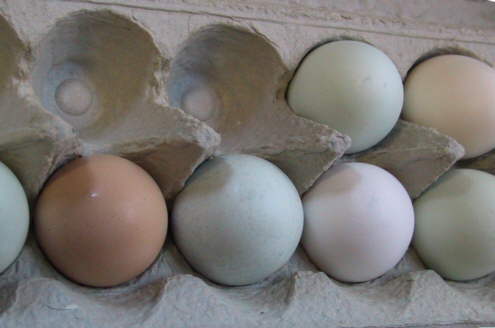
Eggs come in several colors–not just brown and white, but pink and even green. That’s because different breeds of chicken lay different colors of egg.

A range of shell colors

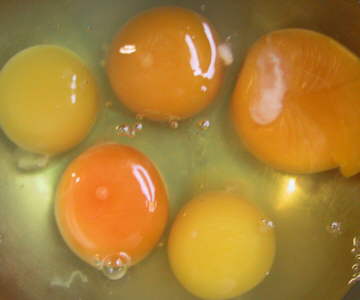
Crack them open and notice the yolk color: Farm eggs have a much more vibrant yolk than do supermarket eggs. Seeing the two of them next to each other really drives the difference home.

compare the colors of the yolks

The difference isn’t just visual, either–it’s a taste difference, too. The fresher, farm raised eggs are richer and eggier. Not to mention the health difference: the farm eggs are free of hormones and antibiotics. One supplier of farm fresh eggs to the Pittsburgh area is Silver Wheel Farm. Read more about them in the article I wrote for the East End Co-op newsletter.

Whaddya mean, there’s more than one type of garlic?

Tuesday, August 22nd, 2006

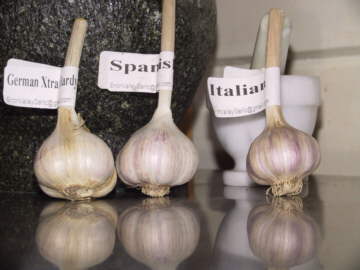
three types of garlic

Yes, it’s true! Though you might only see one variety of garlic at the supermarket, there are indeed many more than that–perhaps as many as 600 different cultivars. A good description of the many types of garlic and the families that they fall into is available at http://www.gourmetgarlicgardens.com/overview.htm, but a quick (and overly simplified) break down of it is that garlic can be hardnecked or softnecked, which refers to the stalk that grows above the ground from the bulb, and can come in a variety of colors. The garlic that you usually find at the grocery store comes from the artichoke garlic subgroup. According to gourmetgarlicgardens, “Artichoke garlics are the commercial growers’ favorite because they are easier to grow and produce larger bulbs than most other garlics.”

The garlics I tasted fall into two other types: Rocambole and Porcelain. The Spanish and the Italian garlics are both Rocambole. The German Extra Hardy is a Porcelain. All three had more flavor and character to them than the supermarket-garlic I compared them to.

(more…)