Archive for the 'Cooking Tips' Category

When You See ‘Raisins’…

Thursday, June 5th, 2008

When you see ‘raisins’ in a recipe, feel free to think beyond dried grapes. Look at that word as a placeholder for ‘dried fruit’ and think of all the variations that are possible.

Larger fruits, such as the apricots and plums, should be cut into smaller pieces for most purposes (who wants to get a cookie with a whole prune* in it?), but once chopped down to raisin-esque size may be substituted and/or combined without hassle. Apricots are known to match well with pistachios; prunes I tend to use in conjunction with other fruits in order to add a new layer of flavor. Tart cherries and cranberries have almost endless possibilities in my mind, and I’ve taken to including them in many of my salads.

Perhaps the classic manifestation of raisins where few people ever think to make substitutions is in the Oatmeal-Raisin Cookie, which most people make with just plain old raisins. Last night, I made a batch that included a mix of raisins, golden raisins, cranberries, and tart montmorency cherries. My recipe: the supposed Neiman Marcus $250 cookie recipe with dried fruit substituted for the chocolate chips

Pittsburghers have several options for where they can find good selections of dried fruits at bulk prices. My favorite three are (in alphabetical order): the East End Food Co-Op, Pennsylvania Macaroni Company, and Trader Joe’s. We tend to ‘cherry pick’ as it were, choosing which fruit to buy where based in large part by how well priced it is. For instance, raisins tend to be the best deal at the Co-Op; cherries at Trader Joe’s, and cranberries at Penn Mac.

*** **** ***** **** ***

Footnotes:

*At this juncture, i think it prudent to put in a word in defense of dried plums. Admittedly, not every prune is good (Dole, for instance, packages a prune which I find to have a somewhat slimy texture)—but a good prune has very sweet flavor and a somewhat chewy texture. Fresh plums aren’t associated with grandparents and regularity–so why are the dried variety? I recommend the ones sold in the bulk section of Pennsylvania Macaroni Company to any Pittsburgher who enjoys this delicacy.

+ Should you decide to make this recipe as a chocolate chip cookie recipe, I strongly suggest that you either omit the Hershey bar or substitute a higher quality chocolate for it. Any recipe with the supposed price tag of twelve and a half scores of dollars ought not include such a low quality chocolate.

Tip from Mom

Wednesday, June 4th, 2008

Whenever you’re using lemon juice for something, zest the lemon before squeezing it and keep the zest frozen for the next time a recipe calls for lemon zest. Also, anytime you have a little leftover lemon juice, freeze it and keep it on hand for recipes. I find that a few seconds in the microwave will thaw just enough of the lemon juice to use in a particular recipe and the rest goes back to the freezer.

Submitted by: Clara Lee Sharrard

Addendum from Jesse:

Obviously, this tip would work for limes and oranges as well.  Also, whenever I zest a citrus fruit, i wash it with soap and water—it makes me feel better about ingesting something that’s been exposed to so many chemicals during the growing process.

Do you have a tip that saves you time in the kitchen that you’d like to share with the readers of Corduroy Orange? If so, email it to me for consideration as a guest post.

What I ate For Dinner, 5/10/08

Tuesday, May 13th, 2008

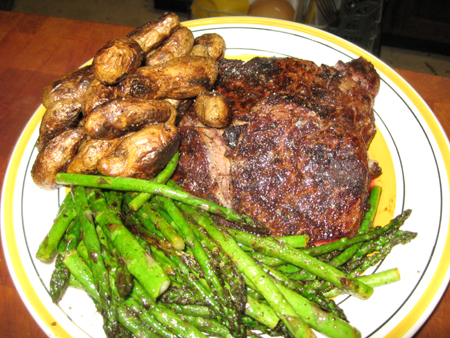
Ribeye Steak of a Grass-fed Beef with Fingerling Potatoes and Asparagus

(more…)

I’m Here to Help

Tuesday, April 1st, 2008

Anyone who was with me in the audience for the Anthony Bourdain lecture at the Carnegie Music Hall in Oakland (Pittsburgh) last night heard Mr. Bourdain compare the programming on the Food Network to pornography: watching actors on screen going through motions that you yourself probably won’t be replicating anytime soon. He contrasted that with Julia Child, who inspired the nation to improve their cooking skills and elevate their cuisine.

I just want you to know that I’m here to help. I want to assist you in recognizing your knife as the most important tool in the kitchen and aid you in learning to use it more efficiently and effectively. From there, once you have the ability to dissect your vegetables instead of chasing them around the cutting board, you’ll find any recipe easier to follow and reproduce, from home fries to cassoulet of beef. Learn to use your knife like a pro.

Moreover, I’m here as a resource for your questions. Email me your culinary problem, and I’ll offer you expert advice. I can almost guarantee you that you won’t find another chef with my expertise who is so easily accessible. Mr. Bourdain? Most certainly not. But, fortunately for you, i work for free under relative obscurity and don’t have to worry about an influx of thousands of emails per day. Which isn’t to denigrate the breadth of my knowledge or the quality of my expertise, but to point out that you have access to my brain that you wouldn’t to Alton Brown’s or Anthony Bourdain’s or Mario Batali’s.

So, take advantage. Step up to the plate and answer Mr. Bourdain’s challenge. Elevate your cuisine.

Two-Pan Stew

Wednesday, March 5th, 2008

I went to a vegetarian potluck dinner the other day and as my contribution took a pot of vegan chili. The host of the event told me as I was leaving that he’d like to have the recipe. I assured him that there was no recipe for it–it’s more of a method, and he said he understood but would like a description of the method just the same.

My secret for making a successful stew begins with potatoes. If you begin by cooking the spuds, you can get a very nice caramelization going on in the bottom of the pan that’s a fantastic flavor base to build from. Also, the starch from the potatoes will thicken the stew as it cooks, so you don’t have to worry about adding a starchy flavor in the form of a cornstarch slurry or a flour-based whitewash to thicken it at the end. Also, the lack of flour makes it a great dish for persons unable to digest wheat gluten. (more…)

Regulating Heat

Sunday, March 2nd, 2008

When a recipe calls for cooking something at ‘high heat’, does that mean that I should turn the knob on my gas stove as far as it can go?  Does ‘high heat’ equate to ‘maximum heat’?  And is ‘low’ the point at which I can first see the gas flame?  I always seem to have a very difficult time regulating the temperature, mainly for cooking things at ‘medium-high’ or ‘medium-low’, but I’m not sure if it’s my gas stove or if I’m just an idiot!

Hopefully you can help.

Cheers,
Heather

Heather—

No need to feel embarrassed or inept; while it seems like a simple question, it really is one that has so many shades of gray, depending on what equipment you’re working with.  If you’ve got a Vulcan or a Blue Star Range, for instance, you’ll have the possibility of much higher heat in your kitchen than I have with my 20-year old Kenmore stove.  And, really, with most average stoves, you’ll have a bit more control over the flame than I’ve got with mine because for some inscrutable region, though the knobs are round, I’ve only got about 90 degrees worth of the circle to control my flame with, so I wind up spending a few minutes whenever I turn it on bent down looking under the pot and tapping the knob with my finger trying to get it to move just a nudge in one direction or the other.

I know you didn’t ask me about the shortcomings of my home kitchen, but I mention them to underscore the point that what one person’s stove says is “high” might be another’s “medium-high” and you can’t really go by the markings on your dial.  Instead, bring all of your senses into the cooking process.  If you’re sauteeing over high heat, for instance, listen to how loudly the stuff in the pan is sizzling.  If it’s so loud that you can’t hear yourself speak over it, your heat is too high.  If it’s barely sizzling at a whisper, your heat is too low.  Instead, seek a conversational tone to the sizzle.

Where your dial points for that will depend on a number of factors, including how long your pan has been heating up on the range, how big the pan is, what the pan is made out of, how much stuff you have in the pan, and how cold the stuff was before you added it.  Every time you put something new into the pan, you cool it down just a bit, and will likely have to nudge the heat slightly higher, at least briefly, to make up for that.

I also trust my senses of sight and smell.  Golden brown=good; black=bad.  If the stuff on the bottom of the pan starts looking too dark, I’ll add a bit of water to the pan and deglaze the fond from the bottom so that nothing gets burnt.  If I smell something starting to burn, I remove the pan from the heat immediately so that it cools down as quickly as possible, and often add a bit of water to the pan at that point, too.
If you’re cooking rice, on the other hand, high heat sort of means as high as it will go.  I mean sort of in a general, kind of fuzzy, and far from definitive sense.  On the one hand, you want to bring the water to a boil relatively quickly.  On the other, you don’t want to scorch the rice to the bottom of the pan.  So, what I wind up doing is starting with the heat at its maximum, and then nudging it down slightly as the water shows signs of approaching a boil.  When the water really does boil, I stir the rice once or twice with a wooden spoon to make sure nothing is stuck to the bottom of the pan, turn the heat down quite low (approaching the lowest) and put the lid on the pan.  To make absolutely certain, i set the timer for 5-10 minutes less than the instructions on cooking the rice tell me to and turn the heat off when the timer goes off, but leave the lid on the pan so that the steam continues cooking the rice but avoiding the application of gross amounts of heat to the bottom of the pan as the last of the water evaporates.

I wish I could give you more specific instructions, but adjusting the height of the flame is one of the key areas where the art comes into the culinary arts.  Nothing ever really cooks the exact same way twice on top of the stove because there are so many factors that contribute to the progression of the dish—not only the height of the flame, but the exact amount of ingredients used, the stage at which additional ingredients are added to the pan, the percentage of water in the specific ingredient you’re using (no two turnips/ carrots/ onions/ etc. are exactly the same), how much attention you’re paying to it, and so on.  One pf the most difficult aspects of cookery to master is knowing when a pan of food needs your attention, and when prodding at it with a spoon or a spatula is unnecessary “tickling” that will disrupt the process of its cooking.

In short, if it’s burning, turn the heat down; but if it’s starting to simmer in its own juices, turn the heat up.  I hope that’s at least some help.  If not, feel free to fly me (first class) to your home and house me for the weekend for some private cooking and knife skills lessons….
Different Ways to Present Mashed Potatoes

Friday, February 22nd, 2008

Re: the Mashed Potato Bar, Gloria asks:

Any suggestions of other items to serve in beside Martini Glasses? Would like something different and cool.
What about parfait glasses (ie the deep, narrow dishes sundaes are often served in)? It’s kind of a twist on the ice cream cone idea listed in the mashed potato bar comments section, but it would work, visually—scoops of spuds mixed with your choice of toppings, topped with a drizzle of gravy. Of course, you’d need enough iced tea spoons for everyone to get to the bottom of their glass.

Or perhaps you could get some long, rectangular plates, such as sushi might be served on. That would give people a chance to make 3 or 4 variations on the mashed potatoes and keep them separated, whilst still appearing somewhat more sophisticated than the army-style three-compartment plate.

Last suggestion I’ve got is to make parmesan cheese dishes by sprinkling a thin layer of parmesan into a hot pan. When it crisps up and releases from the pan, drape the pancake over an upturned bowl to form it. When it cools, it will hold its shape.  It will be a bit fragile, and so you’ll need to serve each of them on a plate, but they wind up fluted and they’re edible, and the cheese flavor should mesh well with the potatoes.
If anyone else has any more ideas for Gloria, please let her know!

The Joy of Stock

Tuesday, January 8th, 2008

No, this hasn’t all of a sudden become a financial page. I’m talking about homemade stocks made by boiling bones and vegetables to extract the flavor and straining through a sieve. Or, in a more nouveau sense, boiling vegetables alone for a much shorter time to extract the flavor and then straining through the sieve. The actual real deal of broths, so much better than what comes in a can or a box (or a cube) from the grocery store.

I save my carcasses in the freezer. One carcass isn’t enough to make a decent pot of stock, I think; might as well save it until I have some more. And then, when I have enough, I’ll often look at them and think, I just don’t have the time to deal with them right now; I’ll do it later.

I finally gave myself a proverbial kick in the pants over the weekend and used my beef and lamb bones to make the tastiest stock de viande I’ve had since…the last time I made my own stock. The truth of the matter is, it’s an easy process: cover bones with cold water, bring to boil, drain and rinse, add vegetables, cover with cold water, bring to boil, let simmer for hours, drain [or conversely, cover vegetables with cold water. Bring to boil, let simmer 45 minutes and drain].

While the stock is simmering, you don’t need to pay any attention to it. You can clean the house, watch tv, go to the store and run some errands, or even sleep! Heck, I did a combination of the above activities while my beef bones were boiling.

The real joy of making your own stock comes after it has cooled, when you pick up the container and you notice that the liquid inside doesn’t flow like water: it has gelled up due to the naturally occurring gelatin in the bones you’ve used. That’s a sign of a well-made stock. For an even more intense flavor (and greater gel effect), reduce your resulting stock until it coats the back of a spoon that you use to stir it (50-75% reduction). Be careful not to scorch the stock while you;re reducing it, or it will get bitter; but properly done over very low heat, you will get glace de viande, or in nouveau terms a beef stock reduction sauce. It is the essence of the hearty beefy flavor,and a small amount drizzled over steak or perogies makes an intense impact on your palate.

So, want the the skinny on making your own stock? Keep reading for semi-exact instructions on what to do. If you want clarification on any of my instructions, don’t hesitate to ask.

(more…)

2 Presentations of One Dish

Thursday, December 20th, 2007

This was a tasty dinner that Aurora and I had last week: butternut squash with chorizo and apples.  It was one of those throw-it-together dinners that worked so well I should’ve been taking notes as I went along except that would have distracted me from my cooking. Maybe I should get a mini recorder and keep a verbal reckoning of what I do, but that’s just me thinking with my fingers.

I started out with a tube of chorizo sausage and some butternut squash and a cast iron pan heating slowly over a low flame.  I diced the squash as the pan heated up.

Once that was done, I browned the sausage in a cast iron pan, breaking it up as it cooked with a wooden spoon.  Because the squash didn’t need my complete and total attention, I used the scraps of it that remained to get some rice started cooking: 2 cups of rice with 4 cups of water and some salt into a pan, bring the water to a boil.
When the sausage had just about fully cooked, I added in my diced squash with a sprinkle of ginger and some cinnamon.  I stirred it all together with the squash and then set about dicing my onion.  When I had the onion cut, I tossed it in the pan and stirred it around with everything else.  The rice water’s boiling so I turn the heat down and put a lid on it.  Bag says 20 minutes but I always set my clock for less time—it’s better to turn the heat off before the rice absorbs all the moisture and let it coast to the end—it’s an easy way to avoid the rice crust at the bottom of the pan.
I ran down to the basement to poke around my apples.  It’s been cool enough down there that they’re all keeping pretty well, so I just grabbed a couple at random without noting what they were.  If you’ve got a cellar where you can keep them, though, I encourage you to buy a supply from an orchard close to you in late October/ early November and house them into the cooler winter months so you have some of fall’s flavor to coax you through the winter months.  I decided not to peel the apples; they wouldn’t be cooking long.  I cut and cored them and added them into the cast iron.

The rice timer goes off, so I crack the lid and check the consistency—close enough to let it coast; I put the lid back on as soon as possible.  I stir the squashage applion mixture with teh wooden spoon–the apples seem cooked but not yet mushy, so I serve it.

Aurora decides to try her own presentation.

Both plates are attractive and we had a fun meal.

Thai Style Steamed Fish

Wednesday, December 12th, 2007

Inspired by a dish I watched chef Norraset Nareedokmai of Silk Elephant and Bangkok Balcony cook (research for an article I wrote for Table Magazine), I decided to try to steam a whole fish in a savory sauce. While I didn’t achieve quite the same quality of results that Nareedokmai achieved with ease, I had fun in my attempt and it came out well, even if I did hit a few bumps along the way. I’ve documented my effort so you can repeat the experiment. Though once you’ve done so, I’d definitely recommend visiting one of Nareedokmai’s restaurant and trying some of his authentic Thai cuisine.

(more…)