Archive for the 'Cooking Tips' Category

Easy Way to Spruce Up Your Salad

Tuesday, July 3rd, 2007

Over the past couple of weeks, as I’ve been making salads with the loads of fresh greens that I get from my Community Supported Agriculture (CSA) share, I’ve gone foraging into my yard for mint leaves to add to my salad mix.  A couple dozen whole mint leaves tossed into the lettuce mix for a salad for two is about right to give you an occasional and enjoyable kick of flavor without the mintiness overpowering your salad.  Plus, it’s cheap and easy to do, because mint grows darned near everywhere!

Preventing Pasta Slabs

Wednesday, May 30th, 2007

Jesse, how do you cook the really wide rice noodles for a dish like Pad See Ew or Chow Fun? I mean the 1″ or wider kind that I think are only available fresh. I buy them from the freezer section at Lotus but can never get the dense, gelatinous slab apart. I end up with white, gooey globs of noodle in my stir-fries.

Moira

I’ve never worked with the exact noodles you’re asking about, but when I worked at an Italian restaurant, we cooked a variety of fresh and frozen pasta, including wide noodles. The two main keys to getting your pasta to come out well are 1) lots of water and 2) stir, stir, stir.

Many times, people try to cook pasta in too small a pot of water. I keep trying to convince Aurora that she needs to get out the big pot every time she cooks pasta, but she resists the idea because the pasta will fit in the smaller one and she doesn’t want to heat up all that water if she doesn’t have to. But, heat up all that water. It really is necessary, especially when cooking the larger noodles.

In addition to there being a larger volume of water to dilute the starch that cooks out of the noodles, the larger pan gives the noodles more room to move as they cook–and you more room to stir them. Helping them swim around the pan is important to unsticking the noodles and preventing them from coming out as a giant slab of pasta.

Lastly, be certain that your water is at a full boil when you add your pasta to it. If you’re putting pasta into water that’s cooler than that, that will contribute to the sticky, gelatinous nature of the results.

Ode to the Bench Scraper

Wednesday, May 16th, 2007

If there’s one piece of kitchen equipment that I’d name as a must-have (after a good knife or three and maybe some cast iron pans), it’s a bench scraper. They’re so useful that I have three of them, so that I’m pretty much always guaranteed to have at least one clean.

The most common use I have for a bench scraper is to collect the pieces of food that I’ve cut and transfer them to a bowl or a hot pan. It’s wide enough that you can fit much more food onto it than you can onto a knife, plus you don’t run the risk of cutting yourself.

In fact, they’re so handy that when I was packing kitchen equipment to take with me on my trip to a woodlands cabin this past weekend, I made sure to take one along.

They’re also handy for portioning dough or scraping cutting boards clean.

Photo credit: Nestor Gomez

So You Want To Roast A Pig?

Wednesday, May 2nd, 2007

I had this crazy idea to have a pig roast in the next month or so, after watching the Indonesia episode of No Reservations. I want to get a whole pig, fill it with herbs, and throw it on a spit in my yard. The first question is, how should I go about procuring a pig? I found this one place:
http://www.wildenfamilyfarms.com/Main/product.html

It looks like it will run about $230 for a 170lb pig. Any ideas for other places or is that a good price from a reputable place? The next piece of the problem is getting the thing gutted. The place above charges $110 for that. How hard is something like that to do myself?

Do you have any other suggestions for things I might be missing?

Thanks,
serge

Serge—

First off, wherever you decide to get the pig, pay them to gut it. It’ll be so much easier, and you won’t have to worry about entrails and noxious odors.

I’m familiar with Wilden Farms, and you’ll get a good product from them. A couple of other Pennsylvania farms offering responsibly raised pork are Mickley Organic Farms, 724.530.2207 and Heilman Family Farm, 724.353.1411. I’m not sure what sort of price they would offer for a whole animal, but it’s probably worth checking.

I’ve never actually roasted a whole pig on a spit. At one of the restaurants where I worked, there was a party that requested three whole pigs that the chef didn’t get in the oven soon enough and then had to turn the heat up on to get them cooked in time. The result was good, but not as good as it would have been if he’d done them properly, for a longer time at a lower heat. But that was in the oven, and I doubt if your oven would fit the whole animal (I know mine probably wouldn’t).

There’s a danger to cooking the pig for too long, though. When my dad was in the Navy, one of his superior officers held a pig roast for his whole unit. The guy in charge of cooking the pig claimed he knew what he was doing, dug a hole in the ground, built a fire, added the pig wrapped in a wet burlap sack (he wanted banana leaves, but they weren’t available), covered it up, and said that it would be perfect the next day. The next day came and everyone showed up at the party (where the side of the garage was obscured by cases of Pabst Blue Ribbon stacked it’s entire length and height). They dug the hole open to find nothing but ashes.

I’m not sure where they were getting their pigs from (I was a long time away from existing at this point), but somehow they ran out and procured another one (maybe the base got pigs in whole?) and started the process again. Trouble was, the house wasn’t on the base, it was in civilian-land, where the neighbors aren’t big fans of a yard full of Pabst-drunk sailors making a ruckus. The cops showed up and told them they had two choices: go inside (the small bungalow-type cottage) or disperse. Everyone knew the second they started their vehicle they;d be in for a DUI, so they all crammed into the cottage. The pig was nowhere near done and everyone was getting hungry, so they ate rare pig. No one got arrested and no one got sick, so there could’ve been worse outcomes to the day.

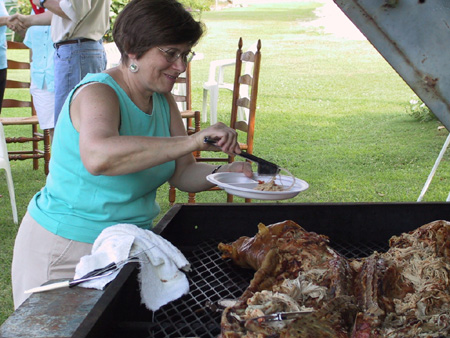
As far as successful pig roasts go, my mom’s family has occasional pig pickin’s that sound like lots of fun, but unfortunately I was never in North Carolina at the same time one was being held. They roast a whole pig, but not on a spit: on a grill made from a converted oil tank.

They flay the pig out and roast it slowly–starting it in the morning so it’ll be done by dinner.

When it gets to be almost done, they dress it with a vinegar-based sauce.
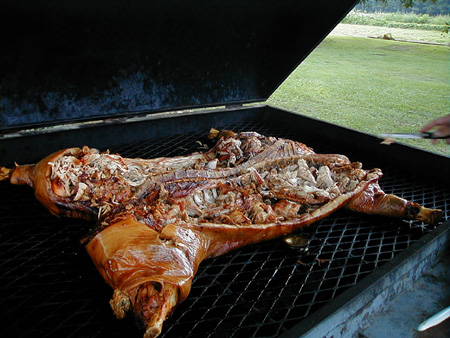
Finally, it’s ready: real pulled pork barbecue.
One thing that you might watch out for when you do roast the pig is the rendered fat: so long as the skin is whole, it’ll contain the fat. But once you cut into the skin, that opens a path for the hot fat to travel; if the pig’s over the fire, that could lead to some insanely large flames.

Not that any of that is much help toward your real question, how to roast a pig on a spit, the short answer to which would be, I don’t know. Here’s some advice from some folks who do know, though, complete with some bitchin’ photos to guide your work.

Good luck! I hope it comes out well.

Photo credit: Jim Sharrard

Hot Pan

Thursday, April 26th, 2007

Hey–
How do I know when my pan is hot enough to saute stuff in?

–Gary

Gary–

There are a couple of ways to check. Generally, you want it to be hot enough that water balls up and rolls around the pan, but not so hot that it’s smoking.

If you don’t feel like splashing water into the bottom of the pan, you can look at the fat that you add to the pan to cook things in. You want the fat to slide around the bottom of the pan easily and coat the whole thing, plus you should see some ripples in it when you tilt the pan and it flows.

If all else fails, add one piece of whatever you’re cooking to the pan. It should sizzle at a moderate volume. If it’s not sizzling, wait a little longer. If it sizzles too loudly, add everything to the pan, but remove it from the heat until it quiets down a little.

Whatever you do, don’t splash water into a pan that already has fat in it: that will lead to hot fat splattering in your face!

Have a question about food or cooking? Email me, and I’ll try to respond in a future post.

Roasting Your Own Coffee

Sunday, April 22nd, 2007

I’ve heard about people roasting their own coffee beans, but only recently did I discover how easy it actually is to do. You wind up with the freshest cup of coffee possible, and the beans cost a heck of a lot less than they would otherwise.

Go to your local coffee roasterie and ask for your favorite kind of bean, green. Store the beans in the freezer until you’re ready to roast them. Then, fill the chamber of your hot air popcorn popper about three-quarters full and turn it on. It’s okay if they smoke a little and you can expect that some stray pieces of the bean’s outer covering will float through the air. But, really, you don’t have to do anything except keep an eye on them, especially as they start to get darker. When they reach your desired level of darkness, pour them out onto a pan to let them cool in a single layer.

The darker you roast the beans, the more carbon they develop (that’s the source of the dark color). A french-roasted bean is basically burnt. It gained its popularity during the reign of King Louis XIV, who was a rather odd man. Among his other obsessions was a fixation on his bowel movements. He reportedly had a specially-built dining chair with a hole in the center so that he wouldn’t miss an opportunity just because he was in the process of eating. He enjoyed the darkly roasted coffee because the excessive quantity of carbon exacerbates coffee’s laxative effect.1

1Allen, Stewart Lee. The Devil’s Cup: A History of the World According to Coffee.

I highly recommend the above volume. It’s a quick, fun read that gives you a new perspective on the ubiquitous beverage and its place in world history.

Hard Boiling Eggs

Sunday, April 15th, 2007

This is one area where you don’t want much room for things to move around in your pan. The more closely the eggs are packed together, the less likely they’ll be to break as they cook.

Put the eggs into a pot just large enough to hold them in a single layer. Because the large end of the egg will float once the eggs are submersed (because that’s where the pocket of air is), you’ll actually want a pot that is just a tad bit too small to fit them all without water in it. When I put these fifteen eggs in the pan, originally there were twelve on the bottom and three more on top.

Cover the eggs with cold water. Add some salt or some vinegar to the water to help any whites that do escape from cracked shells to set more quickly.

Put over a high flame and bring the water to a boil. At this point there are several schools of thought about how to handle the eggs.

(more…)

How Not To Cook Pasta

Saturday, April 14th, 2007

As you can see, there are two types of noodles in this pot: elbows and farfalle. While these two shapes take similar cooking times, no two shapes cook at exactly the same duration, thus you should cook different noodles in separate pots of water.

Additionally, you’ll note how little space there is in the pot. The noodles aren’t really even immersed in water anymore, after having soaked up much of the excess during the cooking process. Noodles should be cooked in a large pot with copious amounts of water. The general guideline is a gallon of salted water per pound of pasta. Otherwise, the noodles don’t have any room to move, you don’t have any room to stir them, the water surrounding them gets saturated with starch, and they wind up getting stuck together.

As for the allegation that the bubbles are indicative of residual detergent in the pot, I’m not so sure about that. My interpretation of the bubbles is that they result from over-starched water as a byproduct of an overly stuffed pot, especially since no similar bubbles were observed when the water was boiling on its lonesome.

Keeping Your Spuds Warm

Friday, April 6th, 2007

For an at home potato bar how would you suggest keeping the potatoes warm? It seems like I am alway plagued by room temp mashed potatoes when ever I try to do something like this.

The easiest way to keep your spuds warm at home is to boil a pan of water and then set your potatoes atop of it.  It won’t preserve their heat forever, but it should work long enough for service, especially if you keep the potatoes covered when you’re not actively scooping them.

Mashed Potato Bar

Thursday, April 5th, 2007

My sister-in-law got married not too long ago, and her reception featured a prime example of sophisticated simplicity: a mashed potato bar.

Almost everyone loves mashed potatoes. I mean, really, what’s not to love? But people never seem to quite agree about what’s the best thing to mix with them: the possibilities are limited only by your range of culinary creativity. Julia’s mashed potato bar featured (and I hope I can remember all of the offerings; I’m sure I’ll be corrected if I leave anything out) irish potatoes with your choice of gravy, orange cheddar cheese, chives, corn, and butter. A healthy selection of classics, to be sure, and it was quite tasty.

Julia already knows, so I’m sure she won’t be offended by my mentioning it here, that I have some ideas for expanding the potato bar to an even wider selection of possible inclusions. I list them here for you, free of charge, but it would be nice of you to invite me to the next occasion where you have one. I love mashed potato bars!
(more…)