Archive for the 'Recipes' Category

Hot Apple Cider

Thursday, October 26th, 2006

So easy yet so good

Lately we’ve had at least a gallon and a half of orchard-fresh apple cider in our fridge at all times. It’s a tasty treat straight out of the icebox, but even better when heated.

I’ll pour some into a saucepan and let it heat slowly on the stovetop. To give it that extra bit of flavor, I spice it up with a cinnamon stick, about 4-6 whole allspice, and about 3 whole cloves. Using the whole spices helps keep sediment out of the bottom of your mug, and it also helps control the strength of the flavors imparted (when using ground cloves, for instance, just a shake too much and they take over the flavor of the drink). Because I keep the heat very low under the pot, the spices have a chance to infuse the beverage with flavor; then, I’ll let it simmer for 5-10 minutes or so just to make sure. If I’m feeling saucy, I’ll add a glug of Calvados to it, though i’ve heard it’s also good with brandy or rum if you’d prefer. Then again, why bother adulterating it when it tastes so good as it is?

Take advantage of the treats autumn offers. Find an orchard not too far from your house and take a weekend drive. You’ll thank yourself for taking the time when you get the tree-fresh apples and fresh-pressed cider.
Making a More Complex Vinaigrette

Friday, October 20th, 2006

Perhaps you want a somewhat moe complex salad dressing than a simple mixture of oil, vinegar, and spices. Something with fruit in it, perhaps? I’ve heard that raspberry vinaigrettes are popular, though I can’t stand the bottled version. On the other hand, if you used a blender and mixed fresh rasberries with balsamic or tarragon vinegar into a puree and then, with the blender on a fairly low setting, drizzled olive oil through the top until the contents of the blender formed a thick emulsification, that would be a raspberry vinaigrette I’d consider eating.

Another nice salad dressing involves using the yolks from a few hard boiled eggs. Mash them in a bowl with some salt, some pepper, and a bit of white wine vinegar. When you’ve formed a paste, add olive oil to the mix, stirring constantly, until you reach your desired consistency. Use the egg whites to garnish the salad over which you pour this freshly prepared and very tasty dressing.

Another example of a more complex vinaigrette is my roasted tomato and balsamic vinegar sauce, which I opted not to label as a vinaigrette because it’s so much more versatile than just being a salad dressing.  However, that’s the case with many such sauces: the raspberry dressing described above would go quite nicely with roast duck, I believe, and the egg-yolk dressing is a nice bacteria-free alternative to hollandaise.

Making a (Simple) Vinaigrette

Tuesday, October 17th, 2006

Who needs the brand name bottle when you can do a better job the Corduroy Orange way?

All you really need to have to make your own salad dressing is some decent vinegar and a bottle of olive oil. Mix 1 part vinegar and 3 parts oil in a container with a tight-fitting lid. Close and shake well.

If you’d like to add a little seasoning to your salad dressing, consider toasting some herbs and spices in the olive oil and then letting it cool before mixing with the vinegar. A nice combination is some freshly ground black pepper with a little garlic powder, some basil, and just a hint of allspice; but play around and see what spices you like. Also consider adding a pinch of salt to the dressing when you mix it.

The results you can achieve are far tastier, much more versatile, less expensive, and come with considerably less packaging as compared to buying bottles of pre-mixed Italian dressing or mix-your-own salad dressing envelopes. So, next time you’re running low on vinaigrette, don’t head for the supermarket! Head for your spice rack instead.

Note: homemade vinaigrettes have a tendency to gel up when refrigerated. If your dressing has no perishable ingredients in it, you can avoid the problem by storing it at room temperature; otherwise, just pull it from the fridge 10-15 minutes before you want to use it.

Also, do not use fresh garlic in any salad dressing you’re not planning on using immediately. Though toasting the garlic in hot oil should kill any microbes that happen to be on the garlic, there is a risk of botulism associated with storing fresh garlic in oil (thus my recommendation above to use garlic powder instead).

Pasta Help-Yourself

Saturday, October 14th, 2006

As I described a few weeks ago to Hungry In Ohio, cooking your own meals is usually preferable to heating up some processed food provided to you in a kit. Sometimes, though, it’s just easier to follow the directions on the back of the pasta casserole box.

Corduroy Orange to the rescue! Here’s a very simple, very tasty recipe for a pasta casserole that you can throw together without much hassle at the end of a long and busy day. (more…)

Huevos con Papas y Col Rizada

Monday, October 2nd, 2006

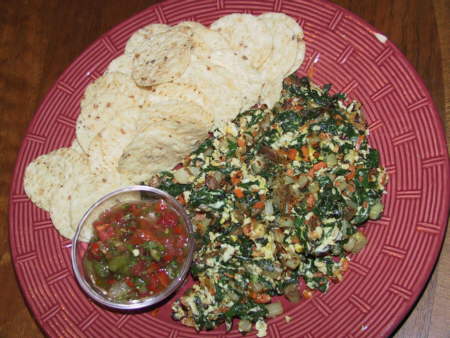
Eggs with Potatoes & KaleI don’t really have any reason to believe that this dish is of Hispanic origin; I just like the way the Spanish name sounds when you say it out loud. Especially if you know how to speak the language with a decent accent, something I’m unable to do. It’s extremely simple to make and quite tasty; an excellent breakfast or dinner. I suppose you could have it for lunch, too, if you really wanted, but most of the time it seems like lunches aren’t cooked on the stove. Probably because most of the time they’re eaten out of paper bags and contain phrases like “salad” and “sandwich” because we tend to eat them on the go; but that’s neither here nor there.

eggs with potatoes and kale

Eggs with potatoes and kale, pictured here with tortilla chips
and roasted tomatillo salsa

I remember the first time I heard of kale. I was watching re-runs of Cheers one evening while I was still in high school. Woody was spokesperson for a health drink he’d never tasted. When he finally did, he spat it out and screamed, “What’s in this stuff?”, looked at the ingredients and spluttered, “Kale! I don’t even know what kale is!”

It wasn’t for another eight or ten years that I actually tasted the stuff. It turns out that kale is a nutritious and tasty leafy green. It might not be something you’re accustomed to having in your produce drawer, but you should become familiar with it because it’s so good! Most of the time it’s braised or steamed; but I like this preparation because it incorporates the heartiness of the kale into the meal as a whole.

(more…)

Building Your Pie on a Firm Foundation

Tuesday, September 26th, 2006

How to make a tasty crust

Dedicated readers might recognize this recipe: I included it as a part of my peach and blueberry struesel pie. Upon further reflection, though, I’ve decided that it’s deserving of its own heading. There are so many other different kinds of pies that can benefit from this recipe because a homemade crust improves any pie. I’d even go so far as to say I’d rather eat a pie featuring a poorly-made crust than a high quality store crust because when you make it yourself you show how much you care.

Lots of people get scared off by the prospect of making their own crust because it has an aura of difficulty about it: whether it’s the impossibility of predicting exactly how much water you’ll need to add or the task of rolling the crust out by hand, I’m not sure. Maybe it’s a bit of both. It shouldn’t be, though. The process is surprisingly easy to learn, and the more you do it, the easier it becomes. Not only that, but the essential ingredients are all things you’re almost guaranteed to have on hand: flour, salt, butter and/or shortening, and water. That’s it. So, take on the challenge of crafting your own crust. You can even pretend it’s as difficult as people seem to think if it increases the adulations your guests shower upon your efforts.

(more…)

Sweet Caramelized Red Onion Marmalade!

Thursday, September 21st, 2006

No, Really, It’s Good!

When I told my sister that we’d be eating it, she turned up her nose at me; but once it was on the table, she was asking for seconds. It’s surprising the first time you taste this dish that its main ingredient is onions. The finished result is sweet and tasty, and there are many uses for it: it’s scrumptious on a zucchini muffin, delicious on roasted winter squash (as pictured), and tasty paired with lean fish. Rolled into a crepe, I call it Crepes Julia, after my sister-in-law, for whom I was supposed to have made it but still have not yet (Maybe in March, Julia!)

red onion marmalade on butternut squash

(more…)

Zucchini Muffins that’ll make you go, “Zounds!”

Wednesday, September 20th, 2006

Zucchini is a great vegetable on which to practice cutting brunoise and fine brunoise—you know, the little, tiny dice cuts. But then what to do with all that zucchini? Personally, I make muffins. They’re quick, they’re easy, and they’re tasty. You can’t ask for much more.

(more…)

Black Beans for 80?

Friday, September 1st, 2006

What’s the best way for me to make a massive quantity of black beans and white rice without burning the contents? At Camp EPP, I made a big batch of black beans, but burned the beans on the bottom, giving it a burny flavor. I’m anticipating around 80 for the party.

If you’re going to cook beans for that many people, you’re going to need a big pot. Heavy-bottomed, if possible. The thinner the material between the food and the flame, the easier it is for the food to scorch.

When you’re cooking indoors, though, you’ve got an advantage over cooking on a campfire: easily regulated temperature. Soak your beans overnight. Then, I’d recommend sauteeing some onions and some garlic in the bottom of your pot, along with a little pepper and whatever other spices you’re using. Then, add your liquid (3-4 cups per pound of dried beans) and your beans, and bring the mixture to a boil. Once it boils, reduce the heat and let it simmer slowly for several hours (a few small bubbles gently breaking the surface.) Adjust the heat as necessary to keep the pot at a steady simmer. Stir it regularly to keep the beans from burning to the bottom of the pan. You’ll need to stir more often as the beans get closer to finishing, because as the cooking liquid thickens, there’s less water to evaporate and the heat becomes less forgiving. If, by unfortunate chance, you do wind up having some beans scorch to the bottom of the pan, don’t scrape them off the bottom when you stir! If you leave them there, they will not have too much of an effect on the finished dish, but if you dredge them up, they will mingle with everything else, lending their bitterness to all the beans.

Have a cooking question? Email me! I’ll respond in a future post.

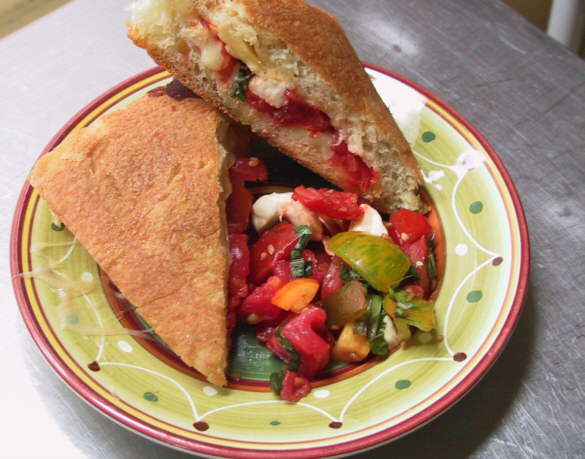
Grilled Cheese and Caprese on Focaccia

Tuesday, August 29th, 2006

I can’t stand bad tomatoes. You know the ones I’m talking about: available year-round out of California, always the same quality no matter what the season. Available on salads everywhere, used simply to add color because the only favor they can contribute is somewhat rancid in nature. It’s no wonder some people don’t like tomatoes, if those are the only tomatoes they’ve been exposed to. The state of our agriculture would be improved tenfold if people didn’t have it in their fool heads that tomatoes are a right, not a privilege.

But enough of the rant, I’m no muckraker. The solution is obvious: plant a few fun varieties of tomatoes in your backyard and experience the harvest for yourself.
grilled cheese and caprese (more…)