Archive for the 'Advice Column' Category

Choosing a Cutting Board

Friday, September 1st, 2006

Howdy! I have a question for you: What kind of cutting board to use? I’ve heard that using a plastic board can dull a knife more quickly than a wooden board, but isn’t plastic more resistant to bacteria than wood? Perhaps you can share your thoughts on the merits and drawbacks of each and what you recommend for folks. Also, do you have any experience with bamboo cutting boards?

At my house, I never have an issue with which cutting board to use. Thanks to my brother, and to the fact that I got married, most of the time I’m using a handsome Boos Block Maple Butcher’s Block.

butcher's blockcutting surface
I have no complaints about this cutting board. It’s well made, attractive, and useful. For those who don’t have space for the freestanding version, Boos also makes smaller cutting boards that store easily in a cupboard. Because I never cut raw meat on it, I don’t have any concerns about bacterial growth; however, just to be certain, I will occasionally wipe it down with a diluted bleach solution. Classy and durable, its only drawback is that it comes from trees. (more…)

Black Beans for 80?

Friday, September 1st, 2006

What’s the best way for me to make a massive quantity of black beans and white rice without burning the contents? At Camp EPP, I made a big batch of black beans, but burned the beans on the bottom, giving it a burny flavor. I’m anticipating around 80 for the party.

If you’re going to cook beans for that many people, you’re going to need a big pot. Heavy-bottomed, if possible. The thinner the material between the food and the flame, the easier it is for the food to scorch.

When you’re cooking indoors, though, you’ve got an advantage over cooking on a campfire: easily regulated temperature. Soak your beans overnight. Then, I’d recommend sauteeing some onions and some garlic in the bottom of your pot, along with a little pepper and whatever other spices you’re using. Then, add your liquid (3-4 cups per pound of dried beans) and your beans, and bring the mixture to a boil. Once it boils, reduce the heat and let it simmer slowly for several hours (a few small bubbles gently breaking the surface.) Adjust the heat as necessary to keep the pot at a steady simmer. Stir it regularly to keep the beans from burning to the bottom of the pan. You’ll need to stir more often as the beans get closer to finishing, because as the cooking liquid thickens, there’s less water to evaporate and the heat becomes less forgiving. If, by unfortunate chance, you do wind up having some beans scorch to the bottom of the pan, don’t scrape them off the bottom when you stir! If you leave them there, they will not have too much of an effect on the finished dish, but if you dredge them up, they will mingle with everything else, lending their bitterness to all the beans.

Have a cooking question? Email me! I’ll respond in a future post.

Don’t kill yourself over the avocado!

Thursday, August 24th, 2006

I don’t live in Pittsburgh, but I could use some knife-skills instruction. I cut myself pitting an avocado the other day. I’d like to avoid more incidents of that kind in the future; bloody avocado doesn’t taste very good.

I want to have my first actual knife skills instructional post up within the next two days, so take a look back soon and there should be something to help you. As far as pitting an avocado goes, it can be a tricky thing to do. The culinary school instructional book tells you to hold the half with the pit in your hand and take a whack at the pit with your knife. Sounds like a great way to slash your wrist to me.

I hope your cut wasn’t anywhere near that serious. To avoid lacerations, I put the half with the pit on the cutting board and (with neither hand anywhere near it) take a whack at the pit with my knife. What’s supposed to happen is that the knife sticks into the pit and you can just twist it out, but if the knife happens to glance off the avocado pit, the worst thing you can do is gouge your cutting board, not commit inadvertant suicide.

Have a culinary question? Email me! I will respond in a future post.

Spices For Fruits

Tuesday, August 22nd, 2006

How do you think cardamom would work with grilled fruits?

I think cardamom would work quite well with grilled fruits, though personally I tend to only use cardamom with apples.  I’m not sure why that is, except that I haven’t really experimented with that spice too much, beyond discovering what happens when you use too much of it: a bitter, astringent flavor dominates the dish.  Therefore, if you’re going to use it, I’d recommend that you don’t use very much: about the same amount as you use nutmeg (~1/4 tsp for most purposes).

I mentioned in my grilled peaches post that I tend to use the same spices for most fruits, but I didn’t explain how or why I adjust what spices I use and in what ratios.  Basically, I try to use more of the spices that I think go well with a particular fruit.

For the peach spice mix, I used a teaspoon of ginger.  Sometimes, for peaches, I might even use more than that: I like how peaches and ginger taste together.  For blueberries, I usually ease up on or eliminate the ginger, but emphasize the cinnamon and allspice.  For apples, I’ll add in about as much cardamom as I use nutmeg.  I use about the same spice mixture when I roast winter squashes (such as pumpkin, acorn, butternut, and hubbard), too: about equal on the ginger as I use for peaches, plus I’ll add in some cloves, but not too much because they can dominate a dish.

Have a question about something culinary?  Email me!  I’ll research the matter and post a response.

Sorry, wrong columnist

Thursday, August 17th, 2006

Why do the size of the kebobs in your first post make me question my masculinity?

Try writing Dan Savage for that one, he might take it on.

email me your culinary questions!

The Best Way to Cook Chef Boyardee? Don’t.

Wednesday, August 16th, 2006

Thanks for this wonderful blog Jesse. I have a question for you, when cooking Chef Boyardee, is the stove top or the microwave more preferred? Also, should the canned parmesan cheese be added before or after cooking? I hope to resolve conflicts that root back from my childhood.

Thanks,
Chris in New Orleans

Dear Chris:

Quite frankly, canned pasta is crap. You’d be much better off cooking yourself dried pasta and heating some sauce out of a jar to go with it. Nutritionally, you’d be cutting a fair amount of unnecessary sodium from your meal; tastewise, you’d be entering the world of adulthood.

The best way to make your adult-style meal of pasta with marinara sauce is to put on a large pot of boiling water (1 gallon of water per pound of pasta being cooked; for a single serving, estimate about 1/4- 1/3 pound pasta). Meanwhile, slice up some onions and some garlic to jazz up your marinara.

Put a small saucepan on medium heat and let it get hot. Drizzle a little bit of oil on the bottom of the pan (enough to liberally cover the bottom). Add a few cranks worth of freshly cracked black pepper, then add your onion (about 1/2 small onion per serving, give or take). Stir the onion around the hot oil with a wooden spoon until it starts to soften up a bit, then add your garlic and a pinch or two of salt. When the garlic starts to brown, add your pasta sauce into the pan and stir it to incorporate the garlic and onion. As the sauce gets hotter, you might want to turn the heat down just a bit to avoid splatters.

When your sauce is pretty much hot and your water is boiling, add your dried pasta to the water. Check the package for cooking directions because different shapes of pasta have different cooking times, but in general you can expect it to take 5-10 minutes to be al dente.

When the pasta is cooked, drain it through a collander and return it to the pan it was cooked in. Add as much sauce as you think is enough and toss it around with the pasta. This would be the proper time to add the parmesan cheese, but don’t feel limited by the stuff in the green can. Especially if you’re trying to impress a date, go for the wedge of aged parmesan and grate it by hand into the pasta. It’s a classy touch.

Pittsburgh Knife Skills Class

Tuesday, August 15th, 2006

Hi Jesse,

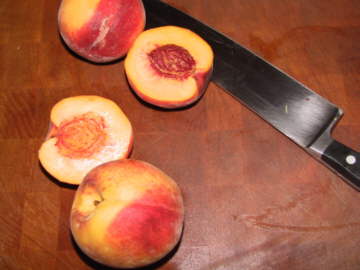
Thanks for the link to your new blog. Will you have a knife skills class? I’d pay you to show me what I should be doing with my knives. (I would also bring my own knives.) I bet you could solicit a handful of people.

Janice

Dear Janice:

That’s not a bad idea. If other people are also interested, I’d be glad to. Anyone participating could expect inexpensive, hands-on training; personalized assistance with their knife skills; and a class that would culminate in the preparation and eating of a tasty meal. So what say you, Pittsburgh? Anyone interested, please post a comment!